
Hiring the right healthcare professionals is one of the most important responsibilities for hospitals, clinics, diagnostic centres, and healthcare organizations. From doctors and nurses to technicians, pharmacists, and healthcare administrators, every position requires the right combination of qualifications, experience, and professional skills.
However, hospitals often face an important question: Should they manage recruitment internally or work with a healthcare recruitment agency?
The answer depends on factors such as hiring volume, urgency, available HR resources, specialist requirements, budget, and long-term workforce planning.
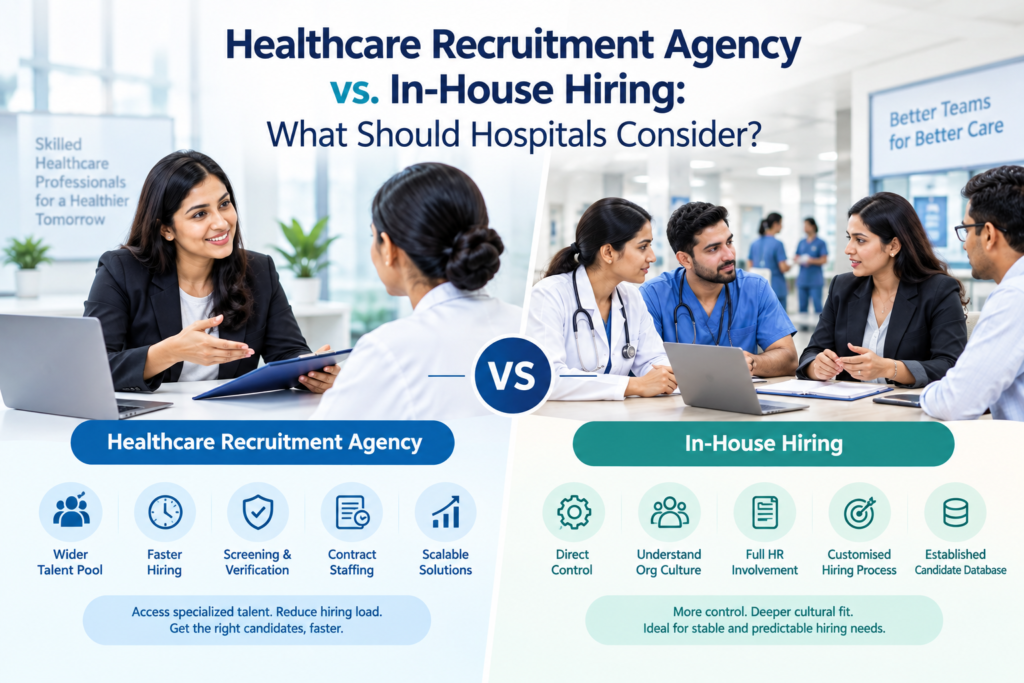
In this guide, we compare Healthcare Recruitment Agency vs. In-House Hiring and explain what hospitals should consider before choosing a recruitment approach.
What Is In-House Healthcare Hiring?
In-house hiring means that the hospital’s internal HR or talent acquisition team manages the recruitment process from beginning to end.
This may include:
- Creating job descriptions
- Advertising vacancies
- Searching for candidates
- Reviewing CVs
- Conducting initial interviews
- Coordinating interviews with department heads
- Checking references and credentials
- Negotiating salaries
- Managing offers and onboarding
For hospitals with an established HR department and predictable hiring requirements, in-house recruitment can provide greater direct control over the hiring process.
However, healthcare recruitment can become challenging when hospitals need to fill multiple positions quickly or require professionals with highly specialized skills.
What Is a Healthcare Recruitment Agency?
A healthcare recruitment agency specializes in sourcing and connecting healthcare organizations with qualified professionals.
A specialized agency can support hospitals with candidate sourcing, screening, credential verification, interview coordination, and onboarding assistance.
Healthcare agency recruitment can be useful when a hospital needs to access a wider talent pool without increasing the workload of its internal HR team.
Brightlist Global provides healthcare recruitment solutions for hospitals, clinics, diagnostic organizations, and pharmaceutical companies, supporting hiring for doctors, nurses, allied healthcare professionals, and other healthcare roles.
Healthcare Recruitment Agency vs. In-House Hiring: Key Differences
When comparing Healthcare Recruitment Agency vs. In-House Hiring, hospitals should look beyond recruitment costs and consider the complete hiring process.
Hiring Factor | Healthcare Recruitment Agency | In-House Hiring |
Candidate sourcing | Access to specialized talent pools | Depends on internal networks and job portals |
Recruitment workload | Agency manages major parts of sourcing and screening | HR team manages the complete process |
Specialized hiring | Useful for niche healthcare positions | May require additional internal expertise |
Hiring flexibility | Permanent, contract, and project-based options | Usually focused on direct employment |
Scalability | Can support bulk or urgent hiring | Depends on HR team capacity |
Market reach | Can access wider candidate networks | Usually depends on existing recruitment channels |
Internal control | Hospital maintains final hiring decision | Hospital manages the complete process |
HR workload | Can reduce administrative workload | Higher internal workload |
Contract staffing | Specialized agencies can provide flexible staffing options | Requires internal management |
Recruitment expertise | Industry-focused recruiters may support specialized hiring | Depends on internal HR expertise |
The right model ultimately depends on the hospital’s workforce requirements and recruitment capacity.
1. Access to a Wider Healthcare Talent Pool
One of the major advantages of working with a healthcare recruitment agency is access to a broader pool of candidates.
Healthcare agencies continuously build candidate networks across different specialties, experience levels, and locations. This can be particularly useful when hospitals are searching for professionals such as:
- Specialist doctors
- Staff nurses
- ICU and critical-care nurses
- Radiologists
- Anaesthesiologists
- Lab technicians
- Pharmacists
- Physiotherapists
- Medical coders
- Healthcare administrators
Internal HR teams can also build strong candidate databases, but maintaining specialized healthcare talent pools requires considerable time and resources.
2. Faster Recruitment for Urgent Positions
Hospitals cannot always afford to leave critical positions vacant for extended periods.
Unexpected employee departures, expansion of departments, seasonal demand, or new healthcare facilities can create immediate staffing requirements.
A recruitment agency can help by using existing candidate networks and recruitment processes to identify potential candidates.
Brightlist Global’s healthcare recruitment process includes understanding role requirements, candidate sourcing, screening and credential verification, followed by interview and onboarding support.
3. Specialized Screening and Credential Verification
Healthcare recruitment requires more than simply reviewing a candidate’s CV.
Hospitals may need to evaluate:
- Educational qualifications
- Professional registrations
- Relevant certifications
- Clinical experience
- Area of specialization
- Previous employment
- References
- Shift availability
A specialized healthcare recruitment partner can support hospitals with structured screening and background verification processes.
This can reduce the amount of preliminary screening handled by the hospital’s internal HR team.
4. Healthcare Contract Staffing for Flexible Workforce Needs
Not every staffing requirement needs to be permanent.
Hospitals may experience temporary workforce requirements because of:
- Seasonal increases in patient volumes
- New department launches
- Employee leave
- Short-term projects
- Expansion periods
- Emergency staffing requirements
This is where healthcare contract staffing can become useful.
Contract staffing allows organizations to bring in professionals for a defined period based on operational requirements.
Brightlist Global offers contract staffing solutions across sectors including healthcare, IT, engineering, and operations, providing organizations with flexible hiring models.
5. Cost Considerations
Cost is an important factor when comparing Healthcare Recruitment Agency vs. In-House Hiring.
In-house recruitment may appear more cost-effective because the hospital already has an HR department. However, the total cost of hiring can include:
- Job advertising
- Recruitment software
- HR employee time
- Candidate sourcing
- Interview coordination
- Background verification
- Administrative work
- Repeated hiring campaigns
A recruitment agency generally operates through an agreed fee structure, allowing hospitals to outsource some or all of these activities.
Hospitals should therefore compare the total recruitment cost, rather than looking only at agency fees. For organizations that are hiring at scale, discussing customized packages and Best Discounted Prices for Companies Requiring Staffing & Hiring in India can also help align recruitment services with the available hiring budget.
6. Hiring Volume and Scalability
The hiring model should also depend on how many employees a hospital needs to recruit.
For example:
Small or occasional hiring:
In-house recruitment may be practical when vacancies are limited and the internal HR team has sufficient capacity.
Multiple vacancies:
An external recruitment partner can help distribute the workload and increase sourcing capacity.
Bulk hiring:
Hospitals opening new branches or expanding departments may benefit from recruitment agencies, RPO services, or contract staffing models.
Brightlist Global provides scalable recruitment solutions including permanent hiring, contract staffing, RPO, executive search, and bulk hiring.
7. Specialized Healthcare Recruitment India Requirements
The healthcare industry in India includes a wide range of roles with different qualifications and experience requirements.
Healthcare recruitment India therefore requires an understanding of the specific requirements of hospitals, clinics, diagnostic centres, pharmaceutical organizations, and healthcare service providers.
For example, the recruitment process for an ICU nurse can be very different from hiring a hospital administrator or medical coder.
A specialized recruitment partner can create sourcing and screening strategies based on the position rather than applying a generic recruitment approach.
8. In-House Hiring Gives Hospitals Greater Direct Control
In-house recruitment also has important advantages.
When recruitment is handled internally, HR teams can work directly with department heads and understand the organization’s culture, working environment, compensation structure, and internal requirements.
The hospital also has complete control over:
- Candidate communication
- Interview stages
- Selection criteria
- Salary negotiations
- Employer branding
- Onboarding
For organizations with experienced recruitment teams and stable hiring requirements, this approach can work effectively.
9. Recruitment Agencies Can Reduce HR Workload
Recruitment involves much more than interviewing candidates.
HR professionals may spend significant time sourcing CVs, contacting candidates, scheduling interviews, following up with applicants, and maintaining recruitment records.
A recruitment agency can handle many of these activities, allowing the internal HR team to focus on employee engagement, retention, workforce planning, compliance, and other strategic responsibilities.
This is particularly useful during periods of rapid expansion or bulk recruitment.
Healthcare Recruitment Agency vs. In-House Hiring: Which Model Should Hospitals Consider?
There is no single recruitment model that works for every hospital.
Hospitals should consider an agency when they:
- Need to fill positions quickly
- Have multiple vacancies
- Need specialized healthcare professionals
- Have limited internal recruitment capacity
- Require contract or temporary staffing
- Are expanding into new locations
- Need support with candidate sourcing and screening
In-house hiring may be suitable when the organization:
- Has a dedicated and experienced HR team
- Has predictable recruitment requirements
- Wants complete control over every recruitment stage
- Has an established candidate database
- Has sufficient time and resources for sourcing and screening
Many organizations can also use a hybrid recruitment model, where internal HR teams manage employer branding, final interviews, and onboarding while an external agency supports sourcing and screening.
What Should Hospitals Check Before Selecting a Recruitment Agency?
Before partnering with a healthcare recruitment agency, hospitals should evaluate:
Industry Experience
Check whether the agency understands healthcare recruitment and the specific roles you need to fill.
Candidate Screening Process
Ask how candidates are screened and whether qualifications, registrations, certifications, and experience are verified.
Recruitment Coverage
Consider whether the agency can support your hiring requirements across the locations where you operate.
Hiring Models
Check whether the agency provides permanent recruitment, contract staffing, bulk hiring, RPO, or executive search according to your requirements.
Communication and Reporting
A structured recruitment process should provide clear updates about candidate pipelines, interviews, and hiring progress.
Pricing and Engagement Model
Hospitals should understand the recruitment fee, replacement policy, payment structure, and any additional charges before beginning the engagement.
Why Consider Brightlist Global for Healthcare Recruitment?
Brightlist Global provides recruitment and staffing solutions for organizations across healthcare and other industries.
Its healthcare recruitment services cover roles including doctors, nurses, laboratory technicians, radiographers, physiotherapists, pharmacists, healthcare administrators, medical coders, and other healthcare professionals.
The company also provides broader recruitment services such as contract staffing, RPO, executive search, background screening, and manpower recruitment.
For companies looking for a Best Placement Agency for Companies, the important consideration should be whether the recruitment partner understands the company’s hiring requirements, provides suitable candidates, communicates clearly, and can scale recruitment support when needed.
How IT Staffing Companies in India Compare
Although this article focuses on healthcare, the same recruitment principles can apply to other industries.
For example, IT staffing companies in India help organizations recruit professionals for software development, cybersecurity, cloud computing, data, IT management, and other technology roles.
Brightlist Global supports both healthcare and IT recruitment, allowing companies with multiple business functions to work with one recruitment partner for different talent requirements.
Conclusion
Choosing between a healthcare recruitment agency and in-house hiring depends on the hospital’s hiring volume, urgency, internal HR capabilities, budget, and specialist workforce requirements.
In-house hiring can provide greater control and may work well for organizations with established HR teams and predictable recruitment needs. A healthcare recruitment agency, on the other hand, can provide additional sourcing capacity, specialized recruitment expertise, flexible staffing options, and support during high-volume or urgent hiring periods.
For many hospitals, a hybrid approach can also be practical. Internal HR teams can remain responsible for organizational fit and final selection, while an external recruitment partner supports candidate sourcing, screening, and staffing requirements.
For hospitals and healthcare organizations exploring healthcare recruitment India, Brightlist Global offers recruitment, contract staffing, RPO, executive search, and manpower solutions designed around different workforce requirements.