
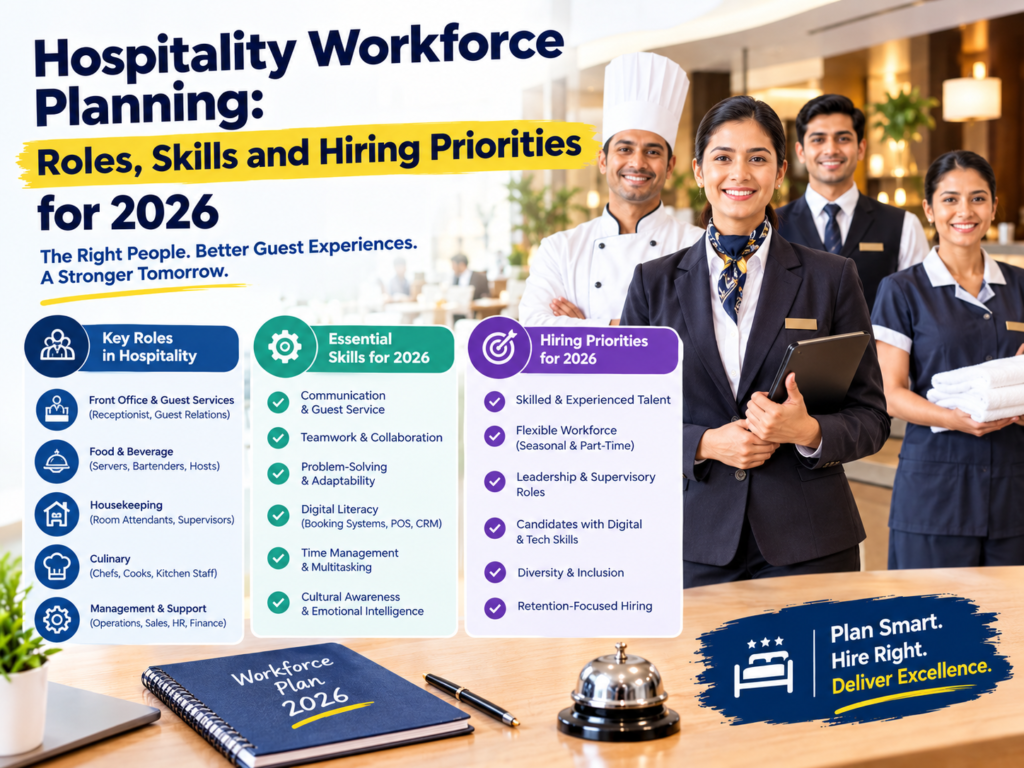
Hospitality businesses need more than enough employees to keep daily operations running. Hotels, resorts, restaurants, catering companies, and event venues need the right mix of people, skills, and experience to deliver consistent service while managing changing customer demand.
In 2026, workforce planning is especially important for hospitality employers preparing for seasonal demand, new property openings, business expansion, and changing guest expectations. Recent industry outlook data also points to continued hiring activity: a TeamLease Services report published in October 2026 says 81% of surveyed travel and hospitality employers plan to expand their workforce in the second half of FY2026–27.
For employers, the challenge is not simply recruiting more people. It is identifying the roles that matter most, understanding the skills required, forecasting staffing needs, and building a practical recruitment plan.
This guide explains how businesses can approach hospitality workforce planning in 2026 and how experienced hospitality consultants in India can support recruitment and staffing requirements.
What Is Hospitality Workforce Planning?
Hospitality workforce planning is the process of identifying how many employees a business needs, which roles must be filled, what skills are required, and when recruitment should take place.
It helps employers align staffing decisions with business objectives, customer demand, operating budgets, and service standards.
An effective hospitality workforce plan typically includes:
- Forecasting staffing requirements by department.
- Identifying skill gaps and hard-to-fill positions.
- Planning recruitment for seasonal and permanent roles.
- Setting hiring priorities and recruitment budgets.
- Improving employee training and retention.
- Monitoring staffing levels, productivity, and service quality.
For example, a hotel preparing for a busy holiday season may need additional housekeeping attendants, front desk executives, restaurant staff, and kitchen employees. Workforce planning helps the hotel estimate these requirements before demand increases.
Why Hospitality Workforce Planning Matters in 2026
1. Managing Seasonal Demand
Hospitality businesses often experience changes in demand during holidays, festivals, wedding seasons, conferences, and major events. Hiring too late can create pressure on existing employees and affect guest satisfaction.
Employers should review booking patterns, occupancy forecasts, event schedules, and previous staffing requirements to estimate future demand.
2. Addressing Skill Gaps
Recruiting enough employees is only one part of workforce planning. Businesses must also identify whether candidates have the necessary technical knowledge, communication skills, and service experience.
Hotels may need professionals with experience in hotel management systems, while restaurants may prioritize food safety, kitchen operations, and customer service.
3. Supporting Business Expansion
Opening a new hotel, restaurant, resort, or hospitality property requires coordinated recruitment across several departments.
Employers need to plan management hiring, frontline staffing, onboarding, and training around the property’s opening schedule.
4. Managing Recruitment Costs
Unplanned hiring can increase recruitment expenses, overtime requirements, and operational pressure. Workforce planning helps businesses forecast staffing budgets and decide which roles require permanent employees, contract staff, or seasonal support.
5. Improving Employee Retention
High employee turnover can disrupt operations and increase repeated recruitment and training costs. Businesses should review employee feedback, workload distribution, career development opportunities, and workplace policies as part of their workforce strategy.
Key Hospitality Roles Businesses Should Prioritize in 2026
The right staffing mix depends on the type of hospitality business, its size, service model, location, and customer demand.
1. Hotel and Resort Operations
Hotels and resorts need employees who can coordinate daily operations and maintain service standards.
Common roles include:
- Hotel general managers
- Front office managers
- Guest relations executives
- Housekeeping supervisors
- Reservation executives
- Hotel operations coordinators
These positions are important for coordinating departments, resolving guest concerns, and maintaining operational consistency.
2. Food and Beverage Services
Restaurants, hotels, banquet facilities, and catering companies require employees who can manage food preparation and deliver reliable service.
Key positions include chefs, kitchen assistants, restaurant managers, waiters, bartenders where applicable, and food and beverage supervisors.
Workforce planning should consider restaurant capacity, expected covers, event bookings, kitchen workload, and shift requirements.
3. Housekeeping and Facility Operations
Housekeeping teams play an important role in maintaining cleanliness, room readiness, and guest comfort.
Businesses should estimate staffing requirements based on room inventory, occupancy forecasts, turnaround times, and service expectations.
For large properties, supervisors and housekeeping managers may also be needed to coordinate schedules, allocate responsibilities, and monitor quality.
4. Sales, Marketing, and Reservations
Hospitality businesses need professionals who can generate bookings, manage customer enquiries, coordinate corporate accounts, and promote services.
Roles may include sales executives, digital marketing professionals, revenue management specialists, reservation executives, and corporate account managers.
These employees help connect operational capacity with business growth objectives.
5. Hospitality Management and Leadership
Senior professionals are essential when businesses need to improve operations, expand into new locations, or establish consistent service standards.
Management hiring may include hotel managers, food and beverage directors, operations heads, and regional hospitality managers.
Because these roles influence multiple departments, employers should define leadership responsibilities and required experience before beginning recruitment.
Essential Skills Hospitality Employers Should Look for in 2026
Hospitality workforce planning should consider both technical and interpersonal skills. The required combination varies by role.
Customer Service and Communication
Employees should be able to communicate clearly, understand customer requirements, and respond professionally to questions or complaints.
Role-Specific Technical Knowledge
Candidates may need experience with hotel management systems, reservation platforms, point-of-sale systems, kitchen equipment, housekeeping procedures, or revenue management tools.
Teamwork and Coordination
Hospitality employees frequently work across departments. Collaboration is essential for managing guest requests, room readiness, food service, and event operations.
Problem-Solving
Employees should be able to respond appropriately to unexpected situations, including scheduling issues, customer complaints, and operational delays.
Adaptability
Demand and workloads can change quickly in hospitality. Employees may need to adjust to different shifts, changing priorities, and varying customer requirements within agreed working conditions.
Supervisory and Leadership Skills
Managers and supervisors need to coordinate teams, manage schedules, monitor performance, and support employee development.
Employers should define which skills are essential for each role and use consistent assessment criteria during recruitment.
How to Build a Hospitality Workforce Plan Step by Step
Step 1: Review Current Staffing Levels
Begin by reviewing the current workforce across departments. Identify vacancies, understaffed shifts, critical positions, employee turnover, and upcoming departures.
Compare the current staffing structure with the level of service the business is expected to deliver.
Step 2: Forecast Future Business Demand
Use relevant business data to estimate upcoming staffing requirements.
Consider hotel occupancy, restaurant reservations, banquet bookings, seasonal patterns, planned events, and business expansion.
Where possible, create different forecasts for normal, peak, and lower-demand periods.
Step 3: Identify Critical Roles and Skill Gaps
Not every vacancy needs the same recruitment priority. Identify roles that directly affect daily operations, safety, customer experience, or business continuity.
Determine whether the requirement can be addressed through recruitment, internal training, promotion, or schedule adjustments.
Step 4: Decide on the Right Hiring Model
Choose the recruitment model based on the duration and nature of the requirement.
Permanent recruitment for ongoing roles.
Seasonal hiring for predictable peak periods.
Bulk recruitment for new property openings or large staffing requirements.
Contract recruitment where the engagement structure and applicable rules permit it.
Internal training or promotion when existing employees can meet the requirement.
Step 5: Set a Recruitment Timeline and Budget
Work backwards from the required joining date. Allow time for candidate sourcing, interviews, verification, offer acceptance, onboarding, and training.
Define the recruitment budget, responsibilities, approval process, and expected outcomes for each vacancy.
Step 6: Track Hiring and Workforce Performance
Monitor recruitment and operational indicators, such as time-to-fill, offer acceptance rate, joining rate, employee turnover, overtime, absenteeism, and training completion.
Use these indicators to identify staffing problems and improve the next workforce planning cycle.
How Hospitality Consultants in India Can Support Workforce Planning
Hospitality consultants in India can help employers organize recruitment activities when internal HR teams need additional industry knowledge, sourcing capacity, or coordination support.
Depending on the provider and agreed scope, recruitment support may include:
- Reviewing job requirements and staffing priorities.
- Sourcing candidates for frontline and management positions.
- Screening resumes and shortlisting suitable applicants.
- Coordinating interviews with hiring managers.
- Supporting bulk hiring for new properties.
- Helping employers plan seasonal recruitment.
- Coordinating candidate communication and onboarding activities.
When evaluating providers, employers should assess industry experience, candidate screening methods, communication, recruitment capacity, pricing transparency, and the ability to support their specific requirements.
How to Evaluate the Top 10 Hospitality Consulting Options in India
Companies searching for the top 10 hospitality consulting providers or the top hospitality consultants in India should compare firms according to their actual service capabilities rather than relying only on online rankings.
Consider these factors:
- Hospitality industry and role-specific recruitment experience.
- Ability to support bulk hiring and new property openings.
- Access to relevant candidate profiles.
- Screening and interview coordination processes.
- Support for permanent and seasonal hiring requirements.
- Experience with management and frontline positions.
- Transparent pricing and clearly defined service terms.
- Communication and recruitment progress reporting.
- Client references or relevant experience.
- Ability to meet agreed hiring timelines.
Not every hospitality consulting firm provides recruitment services. Some focus on hotel operations, business strategy, revenue management, or customer experience. Employers should confirm that a provider offers the specific workforce planning or recruitment support they need.
Why Consider Brightlist Global for Hospitality Recruitment?
Brightlist Global provides hospitality recruitment solutions for businesses that need support with workforce planning, candidate sourcing, and hiring across different hospitality roles.
Its hospitality recruitment services cover areas such as hotels and resorts, restaurants, food and beverage operations, frontline staffing, management hiring, and recruitment for new property openings.
Depending on the employer’s requirements, businesses can discuss:
- Seasonal and bulk hospitality recruitment.
- Front office and guest services hiring.
- Housekeeping recruitment.
- Kitchen and food service staffing.
- Hospitality management recruitment.
- Recruitment coordination and candidate screening.
Brightlist Global can discuss recruitment requirements based on the employer’s staffing priorities, job roles, locations, and hiring timelines.
Learn more about Hospitality Recruitment Consultants in India or visit the Brightlist Global contact page to discuss your business requirements.
Brightlist Global also provides IT recruitment services. However, the main focus of this article is hospitality workforce planning, so IT recruitment should be addressed separately when targeting technology hiring keywords.
Common Hospitality Workforce Planning Mistakes to Avoid
Starting Recruitment Too Late
Waiting until occupancy or event bookings increase can limit candidate availability. Plan recruitment according to forecast demand and allow sufficient time for onboarding.
Ignoring Training Requirements
New employees may need role-specific training before they can work independently. Include training time in the staffing plan rather than treating recruitment as the final step.
Using the Same Staffing Plan Throughout the Year
A fixed staffing structure may not suit businesses with changing demand. Review requirements regularly and adjust staffing levels according to operational needs.
Focusing Only on Recruitment Numbers
Hiring more employees does not automatically improve service quality. Evaluate skills, role suitability, onboarding, and team coordination alongside staffing levels.
Overlooking Employee Retention
Workload, scheduling, management support, and development opportunities can influence employee retention. Review these factors to reduce avoidable turnover.
Failing to Measure Results
Track recruitment and workforce performance so future staffing decisions are based on business data rather than assumptions.
Conclusion
Hospitality workforce planning in 2026 requires employers to look beyond immediate vacancies and prepare for future operational needs. By forecasting demand, prioritizing critical roles, identifying skill gaps, budgeting for recruitment, and monitoring workforce performance, businesses can build more reliable teams.
Working with experienced hospitality consultants in India can provide additional recruitment and coordination support when businesses are expanding, preparing for peak seasons, or opening new properties.
For companies looking for hospitality recruitment support, the best approach is to choose a provider based on its relevant experience, service scope, and ability to meet clearly defined workforce requirements.
Planning your hospitality workforce for 2026? Contact Brightlist Global to discuss recruitment solutions for your business.