
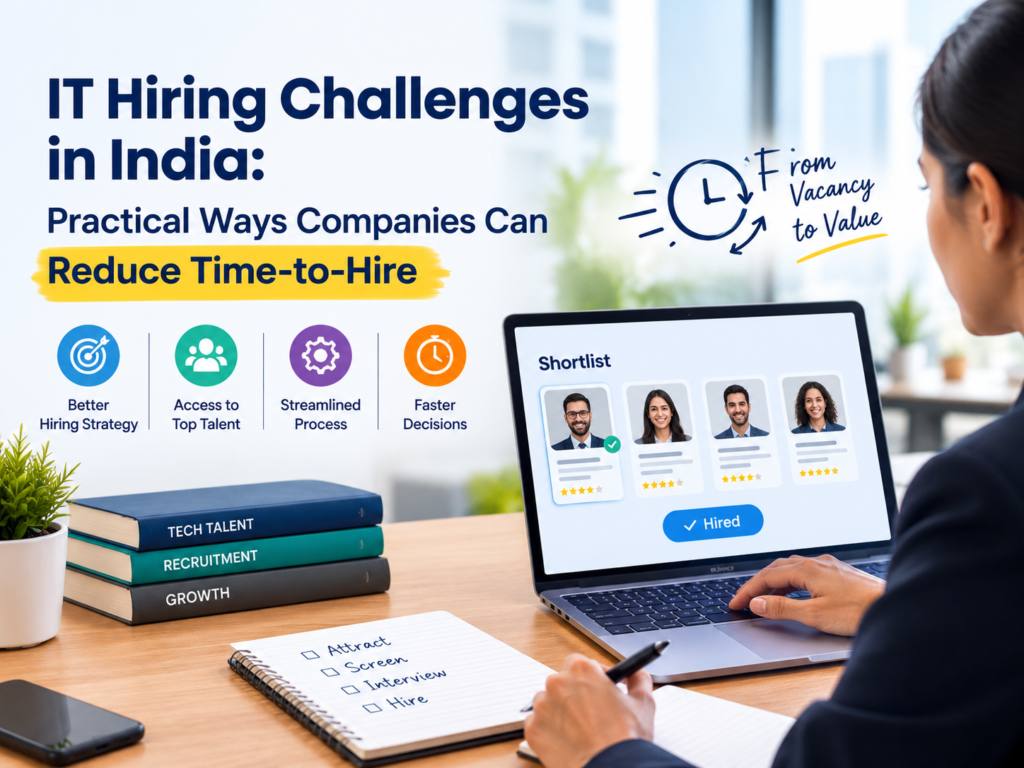
Hiring skilled technology professionals has become a critical priority for businesses looking to expand their teams, deliver projects on schedule, and remain competitive. However, many employers face recurring IT hiring challenges in India, including difficulty finding specialized talent, lengthy interview processes, competing job offers, salary expectations, and candidates dropping out before joining.
For companies building software development teams, strengthening cybersecurity, adopting cloud technologies, or expanding AI capabilities, an unfilled technical position can delay important business initiatives.
The challenge is not always a lack of candidates. In many cases, recruitment takes longer because job requirements are unclear, screening processes are inefficient, hiring managers are unavailable, or decision-making takes too much time.
This is where an experienced IT Recruitment Consultant in India can help companies improve their recruitment process, identify suitable technology professionals, and coordinate hiring more efficiently.
In this guide, we explore the most common IT hiring challenges in India and practical ways businesses can reduce time-to-hire without compromising candidate quality. We also explain how IT staffing companies in India can support permanent recruitment, contract staffing, bulk hiring, and specialized technology recruitment.
What Are the Biggest IT Hiring Challenges in India?
India has a large technology workforce, but finding professionals who match a company’s exact technical requirements, experience level, budget, and joining timeline can still be difficult.
A company hiring a general software developer may face different challenges from an organization searching for a senior cloud architect, cybersecurity specialist, AI engineer, or engineering manager.
Understanding the reasons behind hiring delays is the first step toward improving recruitment performance.
1. Shortage of Candidates With Specialized Technical Skills
Technology requirements continue to evolve. Companies may need professionals with experience in artificial intelligence, machine learning, cloud infrastructure, cybersecurity, DevOps, data engineering, enterprise applications, or specialized software frameworks.
Although many candidates may apply for a technical position, only a smaller proportion may meet the employer’s practical skill and experience requirements.
For example, a company hiring an AWS DevOps Engineer may require hands-on experience with cloud infrastructure, CI/CD pipelines, automation, monitoring, and containerization. A candidate with general IT experience may not be suitable for the position.
How companies can address this challenge:
- Define the essential technical skills before publishing a vacancy.
- Separate mandatory requirements from skills that can be learned after joining.
- Evaluate practical experience rather than relying only on job titles.
- Use technical assessments that reflect actual job responsibilities.
- Consider candidates with transferable skills when appropriate.
A focused sourcing and screening strategy can help reduce time spent reviewing unsuitable profiles.
2. High Competition for Experienced IT Professionals
Experienced developers, cloud engineers, cybersecurity specialists, and technical leaders often receive opportunities from multiple employers.
When recruitment takes several weeks, candidates may accept another offer before the hiring company completes its interview process.
This is especially relevant when businesses are recruiting for critical positions that directly affect product development, infrastructure, or project delivery.
Companies should therefore evaluate not only how quickly they source candidates but also how efficiently they move suitable applicants through interviews and offer discussions.
Practical solutions include establishing clear interview timelines, maintaining regular candidate communication, and ensuring hiring managers provide feedback promptly.
3. Lengthy Interview and Approval Processes
A lengthy recruitment process is one of the most manageable IT hiring challenges in India.
Some companies require multiple technical interviews, HR discussions, managerial approvals, and compensation reviews. While thorough evaluation is important, unnecessary duplication can slow down hiring.
For example, if a candidate completes a technical assessment but must wait several days for feedback before proceeding to the next round, the recruitment timeline becomes longer without necessarily improving the decision.
Companies can improve the process by:
- Defining the number of interview rounds in advance.
- Assigning a decision-maker to each stage.
- Scheduling interviews in advance wherever possible.
- Using consistent evaluation criteria.
- Setting internal deadlines for interview feedback.
- Removing duplicate assessments that do not add meaningful information.
A structured interview process helps employers make decisions faster while maintaining appropriate hiring standards.
4. Salary Expectations and Recruitment Budget Limitations
Compensation can become a major obstacle when a company’s budget does not match the requirements of the role.
This is common when employers seek highly specialized skills, extensive experience, or immediate availability without reviewing current market conditions.
An unrealistic compensation range may reduce the number of qualified applicants or result in repeated offer rejections.
Companies searching for Best Discounted Prices for Companies Requiring Staffing & Hiring in India should evaluate the total value of recruitment services rather than choosing a provider solely because its fees are lower.
To manage hiring costs effectively:
- Establish an approved compensation range before sourcing begins.
- Review the requirements for seniority and experience.
- Compare recruitment proposals and clarify the included services.
- Consider contract staffing when it genuinely fits the project.
- Track recruitment expenditure and cost per successful hire.
The objective is to balance recruitment costs, candidate quality, and business requirements.
5. Candidates Rejecting Offers or Failing to Join
A recruitment process is not complete when a candidate is shortlisted or selected. The candidate must also accept the offer and join the organization.
Candidates may decline offers because of compensation differences, counteroffers from current employers, delayed communication, changes in job responsibilities, or a mismatch between expectations and the final offer.
Companies can reduce this risk by discussing compensation, notice periods, availability, role expectations, and competing offers early in the process.
Recruiters should maintain communication with candidates throughout the hiring journey and identify potential concerns before the offer stage.
Clear communication is particularly important for senior and specialized technical positions, where candidates may have several opportunities to consider.
6. Unclear Job Descriptions and Unrealistic Requirements
Some vacancies combine too many responsibilities or demand an unnecessarily broad range of skills.
For instance, a company may request a developer who is an expert in several programming languages, cloud platforms, database systems, cybersecurity, project management, and multiple years of experience within a limited salary range.
Such requirements can make sourcing more difficult and reduce the number of relevant applications.
Before starting recruitment, hiring managers and HR teams should agree on:
- The main responsibilities of the role.
- Essential technical skills.
- Preferred or additional skills.
- Required experience and qualifications.
- Salary range and employment model.
- Expected joining date.
Clear requirements help an IT Recruitment Consultant in India identify candidates who are more closely aligned with the company’s needs.
7 Practical Ways Companies Can Reduce IT Time-to-Hire
Reducing time-to-hire requires improvements across the entire recruitment process. Faster sourcing alone will not solve delays caused by interviews, approvals, compensation discussions, or candidate communication.
Here are seven practical strategies businesses can implement.
1. Build a Clear and Realistic Hiring Plan
Start by identifying the number of vacancies, technical requirements, hiring priorities, and expected joining dates.
Companies recruiting for multiple projects should distinguish between business-critical positions and roles that can be filled later.
For example, a software company preparing to launch a product may prioritize backend developers, QA engineers, DevOps specialists, and a technical project manager.
A clear hiring plan allows HR teams and recruitment partners to allocate resources according to business priorities.
2. Use Targeted Candidate Sourcing
Publishing a job advertisement is only one way to find technical talent.
Depending on the role, candidate sourcing can include professional networks, relevant technology communities, referrals, existing talent databases, specialist job portals, and targeted outreach.
For senior or niche positions, direct sourcing may be more effective than relying exclusively on applications.
Companies should choose sourcing methods according to the required skills, experience level, location, and hiring timeline.
3. Introduce Structured Technical Screening
Recruiters should understand the difference between a candidate who matches keywords on a resume and one who can perform the required job responsibilities.
A structured screening process can evaluate relevant experience, technical knowledge, project contributions, communication, and role-specific expectations.
For example, a company hiring a data engineer may prioritize experience with data pipelines, SQL, cloud platforms, and data processing tools.
Screening should identify whether candidates meet the essential requirements before they reach the hiring manager.
This reduces unnecessary interviews and allows technical teams to focus on suitable applicants.
4. Reduce Delays Between Interview Rounds
Interview scheduling and feedback can create avoidable bottlenecks.
Companies should agree on an interview process before recruitment begins and make sure the relevant decision-makers are available.
Where appropriate, related interviews can be scheduled close together. Interviewers should also use consistent scorecards to record technical suitability, relevant experience, and areas requiring further evaluation.
A clear process makes it easier to compare candidates and avoid repeated discussions about the same requirements.
5. Make Compensation and Job Expectations Transparent
Candidates should understand the role, salary range, work arrangements, responsibilities, and expected joining timeline before progressing too far into the recruitment process.
If compensation is discussed only at the final stage, a company may lose a candidate after investing considerable time in interviews.
Transparency helps identify mismatches early and supports more informed decisions on both sides.
6. Maintain an Active Talent Pipeline
Companies with recurring IT hiring requirements can benefit from maintaining relationships with suitable candidates before vacancies become urgent.
An active talent pipeline may include professionals previously interviewed, candidates who expressed interest in future roles, referrals, and relevant talent identified through targeted sourcing.
Candidate information and consent should be managed appropriately, with personal data handled according to applicable privacy requirements.
A maintained pipeline can reduce the time needed to start sourcing whenever a new requirement arises.
7. Partner With an Experienced IT Recruitment Consultant
An external recruitment partner can help companies coordinate sourcing, initial screening, shortlisting, and interview scheduling.
This can be especially useful when internal HR teams are handling multiple vacancies or lack dedicated resources for specialized technical hiring.
An experienced recruitment consultant should understand the technical requirements before sourcing candidates and should communicate clearly about progress, challenges, and expected next steps.
Companies can explore Brightlist Global IT Recruitment Consultant in India service to learn more about recruitment solutions for technology hiring.
How IT Staffing Companies in India Can Support Different Hiring Needs
Not every IT hiring requirement needs the same recruitment model. The most suitable approach depends on whether a company needs a permanent employee, temporary project support, multiple technical professionals, or senior technology leadership.
Permanent IT Recruitment
Permanent recruitment is suitable for companies building long-term engineering, product development, cybersecurity, data, or infrastructure teams.
The process focuses on finding professionals whose technical capabilities, experience, and working style align with the organization’s long-term needs.
Contract IT Staffing
Contract staffing can help businesses access technical professionals for defined projects or temporary resource requirements.
For example, a company implementing a cloud migration may require additional cloud engineers and DevOps specialists during a specific phase of the project.
The employment arrangement, contract duration, responsibilities, and applicable legal requirements should be clearly established.
Bulk IT Hiring
Businesses expanding development teams, establishing new technology functions, or managing large implementation projects may need to recruit multiple professionals within a defined period.
Bulk hiring requires coordinated sourcing, consistent screening criteria, interview scheduling, and recruitment reporting.
Executive Search for Technology Leaders
Senior technology appointments often require a targeted and confidential search process.
Companies recruiting a Chief Technology Officer, Engineering Manager, Technical Architect, IT Director, or Head of Technology may need to assess leadership experience alongside technical expertise.
Recruitment Process Outsourcing
Recruitment Process Outsourcing (RPO) can be useful for businesses with recurring hiring requirements or high recruitment volumes.
Depending on the agreed service scope, an external recruitment partner may support sourcing, screening, interview coordination, candidate communication, and recruitment administration.
Companies evaluating IT staffing companies in India should compare these models according to their workforce requirements and business objectives.
How to Measure and Improve Time-to-Hire
Companies should track recruitment performance to identify where delays occur and which changes improve efficiency.
Time-to-hire is commonly measured from the point a candidate enters the recruitment process to the point the candidate accepts an offer. Companies should define their measurement consistently so that results can be compared across roles and reporting periods.
Other useful recruitment metrics include:
Recruitment Metric | What It Helps Measure |
Time to shortlist | How quickly suitable candidate profiles are identified |
Time-to-hire | How long the candidate hiring journey takes |
Interview-to-selection ratio | How effectively shortlisted candidates match requirements |
Offer acceptance rate | How often candidates accept employment offers |
Joining rate | How many selected candidates actually join |
Cost per hire | Recruitment expenditure for each successful hire |
Early retention | Whether new employees remain in their positions during the initial period |
For example, if a company receives relevant candidate profiles quickly but takes several weeks to complete interviews, the main bottleneck may be internal decision-making rather than sourcing.
If candidates repeatedly reject offers, the company may need to review compensation, role expectations, communication, or the time taken to issue offers.
Tracking these metrics helps employers address the actual cause of delays instead of simply increasing the number of applications.
How to Choose the Right IT Recruitment Consultant in India
Choosing a recruitment partner should involve more than comparing the number of resumes agencies can provide.
Businesses need a consultant who understands the role requirements, recruitment priorities, hiring model, and expected timeline.
Consider these factors before engaging an agency.
Technical recruitment knowledge: Does the agency understand the skills required for the positions you need to fill?
Candidate screening: Does it assess relevant experience and role suitability before forwarding profiles?
Hiring flexibility: Can it support permanent hiring, contract staffing, bulk recruitment, or executive search when required?
Communication: Will your team receive regular updates on sourcing progress, interviews, and candidate feedback?
Commercial transparency: Are recruitment fees, service scope, payment terms, and applicable replacement conditions clearly explained?
Relevant experience: Can the agency demonstrate experience supporting similar roles or hiring requirements?
Companies looking for a Top Recruitment Agency in India for Companies should select a partner based on demonstrated suitability, transparent processes, and the ability to support their actual recruitment needs.
You can also read How to Choose the Right IT Recruitment Consultant in India for Your Business for a more detailed guide to evaluating recruitment partners.
Why Companies Can Consider Brightlist Global for IT Recruitment
Brightlist Global provides recruitment and staffing solutions for businesses looking to hire technology professionals across India.
Its IT recruitment services cover permanent recruitment, contract staffing, bulk hiring, and executive search for technology roles. Depending on the company’s requirements, recruitment support can be aligned with the role, experience level, hiring volume, and business timeline.
The recruitment team supports hiring requirements across technology areas such as:
- Software development
- Cloud computing and DevOps
- Artificial intelligence and machine learning
- Data engineering and analytics
- Cybersecurity
- Quality assurance and testing
- Enterprise technologies
- Technology management and leadership
For employers, the objective is to identify candidates who meet the essential requirements and support a more organized hiring process.
Companies can discuss their open positions, required skills, approved compensation ranges, hiring timelines, and preferred employment models to understand the available recruitment options.
Explore Brightlist Global’s IT Recruitment Consultant in India services to learn more about hiring technology professionals.
Businesses with broader workforce requirements can also review Brightlist Global’s recruitment services for additional staffing and recruitment solutions.
Common Mistakes That Increase IT Hiring Time
Even when companies have access to a large candidate pool, certain recruitment practices can create unnecessary delays.
Starting Recruitment Without Approved Requirements
If the job description, salary range, and essential skills are not agreed upon, the recruitment team may need to restart sourcing after receiving feedback.
Overcomplicating the Interview Process
Too many interview rounds can increase delays without necessarily improving candidate evaluation. Each stage should have a clear purpose.
Delaying Feedback and Decisions
Candidates may lose interest when interview results or next steps are not communicated promptly.
Ignoring Candidate Availability
Notice periods, joining dates, competing offers, and work arrangements should be discussed early enough to prevent avoidable surprises.
Focusing on Quantity Instead of Suitability
Sending large numbers of resumes does not automatically improve recruitment outcomes. Relevant shortlists are more useful when hiring managers have limited time.
Selecting a Recruitment Partner Only on Price
Companies looking for Best Discounted Prices for Companies Requiring Staffing & Hiring in India should evaluate the full service offering, screening quality, communication, and commercial terms. A lower fee may not represent better value if the recruitment process generates unsuitable profiles or requires substantial additional work from internal teams.
Conclusion
IT hiring challenges in India can affect project delivery, workforce planning, and business growth when recruitment processes are not structured around the company’s actual requirements.
Clear job descriptions, targeted candidate sourcing, consistent screening, efficient interviews, transparent compensation discussions, and timely decisions can help businesses reduce avoidable hiring delays.
For companies managing specialized technical vacancies, contract staffing requirements, or bulk IT recruitment, working with a suitable recruitment partner can provide additional sourcing and coordination support.
Brightlist Global offers IT recruitment and staffing solutions for companies looking to build technology teams across India.
Whether you need software developers, cloud engineers, cybersecurity professionals, data specialists, or experienced technology leaders, the first step is to define your hiring requirements and establish a clear recruitment plan.
Looking to hire IT professionals in India?
Connect with Brightlist Global to discuss your vacancies, required technical skills, hiring volume, and expected joining dates.
Website: https://brightlistglobal.com/it-recruitment-consultant-india/