
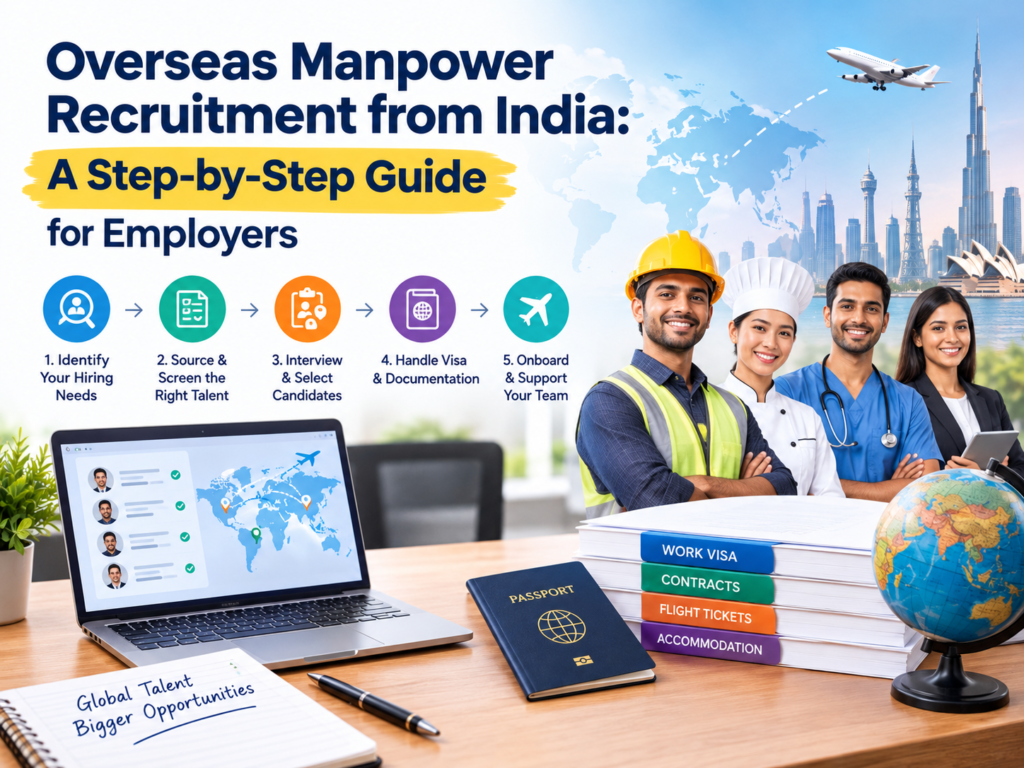
Hiring the right workforce is one of the most important decisions for companies managing international operations, expanding into new markets, or executing overseas projects. Whether a business needs engineers for an infrastructure project, IT professionals for a technology team, healthcare workers for a medical facility, or skilled technicians for industrial operations, finding suitable candidates can be challenging without a structured recruitment strategy.
For international employers, India offers access to a diverse talent pool across technical, professional, managerial, and skilled-trade roles. However, successful overseas manpower recruitment from India involves more than sourcing resumes. Employers need to define workforce requirements, evaluate candidates, plan recruitment costs, coordinate interviews, and address employment and immigration requirements in the destination country.
Working with an experienced Overseas Recruitment Agency in India can help businesses organize these activities and identify candidates who match their specific hiring requirements.
In this guide, we explain how employers can recruit manpower from India, choose the right recruitment partner, manage staffing costs, and develop an efficient international hiring process with support from Brightlist Global.
What Is Overseas Manpower Recruitment from India?
Overseas manpower recruitment from India is the process of identifying and hiring Indian professionals, skilled workers, technicians, and other employees for jobs located outside India.
International employers may use this recruitment approach when they need specialized skills, additional project manpower, experienced professionals, or employees for new business operations.
The recruitment process can involve:
- Understanding workforce requirements and job descriptions
- Identifying suitable candidates in India
- Screening resumes and evaluating qualifications
- Conducting interviews and skill assessments
- Verifying relevant experience and credentials
- Coordinating employment offers and joining timelines
- Managing recruitment-related documentation
- Addressing applicable overseas employment and immigration requirements
For example, a construction company developing a project in the UAE may require civil engineers, site supervisors, electrical technicians, and project managers. Instead of sourcing every position independently, the company can work with an overseas recruitment agency in India to coordinate candidate sourcing and recruitment activities.
The exact process depends on the industry, destination country, employment arrangement, and requirements of the employer.
Why Do International Companies Recruit Manpower from India?
Companies recruit from India for several business reasons. The suitability of this approach depends on the skills required, candidate availability, compensation expectations, and the conditions of the destination market.
1. Access to a Diverse Talent Pool
India has professionals across industries such as information technology, engineering, healthcare, manufacturing, construction, hospitality, logistics, finance, and business operations.
This diversity allows employers to search for candidates with different qualifications, experience levels, and technical specializations.
2. Recruitment for Specialized Positions
Some projects require niche technical capabilities or industry-specific experience. International employers may expand their sourcing efforts to India when their local candidate pool does not meet those requirements.
For example, a technology company may need cloud engineers, cybersecurity professionals, or experienced software developers for a specialized implementation project.
3. Support for Large-Scale Projects
Construction, manufacturing, infrastructure, healthcare, and hospitality businesses may need multiple employees within a defined period.
Overseas manpower recruitment can help employers coordinate recruitment for different departments and positions through a structured hiring plan.
4. Support for International Expansion
Businesses entering a new market may need employees who can support project delivery, technical operations, management, or service delivery.
A well-planned recruitment strategy helps employers identify suitable candidates while keeping workforce requirements aligned with business objectives.
5. Flexible Recruitment Solutions
Different projects require different employment models. Employers may need permanent employees, contract professionals, temporary workers, or senior specialists.
The appropriate recruitment model depends on the duration of the assignment, the role, applicable employment regulations, and the company’s operational needs.
Step-by-Step Process for Overseas Manpower Recruitment from India
A structured recruitment process helps international employers manage candidate sourcing, evaluate suitability, and coordinate hiring more effectively.
Step 1: Define Your Manpower Requirements
Before contacting recruitment agencies, prepare a detailed list of vacancies and the skills required for each position.
Your workforce plan should include:
- Job titles and responsibilities
- Number of employees required
- Project or workplace location
- Educational qualifications and certifications
- Required experience and technical skills
- Salary range and employment benefits
- Employment type and contract duration
- Expected joining dates
- Any mandatory licensing or language requirements
For example, an employer planning a manufacturing facility may require production engineers, quality inspectors, maintenance technicians, machine operators, and a plant supervisor.
Each position should have its own job description and screening criteria. Clear requirements help recruitment teams focus on suitable candidates instead of forwarding large numbers of unrelated profiles.
Step 2: Choose an Overseas Recruitment Agency in India
The recruitment partner you select can influence candidate quality, communication, recruitment timelines, and the overall hiring experience.
When comparing overseas recruitment agencies in India, evaluate their experience with the relevant industry, sourcing methods, screening procedures, and understanding of international recruitment requirements.
Important questions to ask include:
- Does the agency understand our industry and job requirements?
- Can it support the required number of vacancies?
- How are candidates sourced and screened?
- What recruitment services are included?
- How are interviews and candidate feedback coordinated?
- What are the recruitment fees and payment terms?
- How are relevant compliance requirements addressed?
- Can the agency support the required destination market?
Employers should also verify any applicable registration or authorization requirements for recruitment agents conducting overseas recruitment from India.
Brightlist Global offers overseas recruitment solutions for international employers seeking Indian professionals and skilled manpower across multiple industries.
Explore Brightlist Global’s Overseas Recruitment Agency in India services to understand the recruitment support available for business hiring requirements.
Step 3: Prepare a Recruitment Budget
Recruitment costs should be considered before sourcing begins. Employers need to understand the cost of hiring employees and the services included in their recruitment agreement.
Depending on the role and destination, the budget may include:
- Recruitment and candidate sourcing fees
- Candidate assessments and background checks
- Salary and applicable employee benefits
- Work authorization and immigration-related expenses
- Medical examinations or professional licensing, where required
- Travel and relocation costs
- Accommodation or onboarding support, where applicable
- Training and project-specific certification expenses
Not every cost applies to every recruitment arrangement. Employers should identify which expenses they will bear and which responsibilities belong to other parties under the agreed employment arrangement.
How Can Companies Find Cost-Effective Recruitment Services?
Businesses searching for Best Discounted Prices for Companies Requiring Staffing & Hiring in India should compare recruitment proposals based on the total service offering.
A lower recruitment fee is not necessarily better value if the proposal does not include the screening, coordination, or support your hiring requirements demand.
To manage recruitment costs:
- Finalize job descriptions before candidate sourcing begins.
- Establish an approved salary range for each position.
- Group related vacancies into a coordinated hiring plan.
- Compare the scope and terms of multiple proposals.
- Clarify additional charges and replacement conditions.
- Track cost per hire and recruitment timelines.
- Choose an employment model that fits the actual project requirements.
The goal is to manage recruitment expenditure while maintaining appropriate candidate quality and hiring standards.
Step 4: Source Suitable Candidates from India
Once requirements and budgets are approved, the recruitment team can begin identifying candidates who match the employer’s criteria.
Candidate sourcing methods may include professional networks, job portals, industry contacts, referrals, existing talent databases, and targeted outreach.
The right approach depends on the role and candidate profile.
For example, recruiting a senior engineering manager may require targeted outreach and leadership assessment, while hiring multiple technicians may require a different sourcing and screening strategy.
A recruitment partner should understand the employer’s essential requirements before beginning sourcing.
Step 5: Screen Resumes and Verify Candidate Suitability
Resume screening helps identify candidates whose experience and qualifications align with the vacancy.
However, a resume alone may not establish whether a candidate is suitable for an overseas position.
Employers should assess relevant factors such as:
- Educational qualifications
- Professional experience
- Technical skills and practical knowledge
- Industry-specific certifications
- Communication skills relevant to the role
- Experience with similar projects
- Availability and notice period
- Willingness to relocate
- Eligibility for required professional licensing or employment authorization
Where appropriate, employers can use technical assessments, reference checks, and background verification.
For regulated occupations, verify that the candidate meets the relevant licensing and qualification requirements before confirming the appointment.
Step 6: Coordinate Interviews and Final Selection
Interview coordination can become complicated when international employers and candidates are in different time zones.
A defined interview process helps reduce scheduling delays and ensures that candidates receive clear information about the next steps.
Companies should establish:
- The number of interview rounds
- The people responsible for evaluating candidates
- Technical or practical assessment requirements
- Feedback deadlines
- Final approval authority
- Compensation and offer approval procedures
For bulk recruitment, employers may also consider structured interview schedules to evaluate multiple candidates efficiently.
Once the preferred candidate is selected, confirm compensation, responsibilities, employment conditions, joining timelines, and any outstanding requirements before issuing the final offer.
Step 7: Complete Employment Documentation and Compliance Checks
International recruitment requires careful attention to the laws and procedures applicable in India and the destination country.
Depending on the recruitment arrangement, employers may need to address:
- Employment contracts
- Work permits and employment visas
- Passport and identity documentation
- Educational and professional qualification verification
- Background screening
- Medical examinations, where required
- Professional licensing and registration
- Destination-country labor regulations
- Insurance, payroll, and applicable employee benefits
Indian overseas recruitment requirements should also be considered. The Ministry of External Affairs provides information on the regulatory framework for overseas recruitment, including recruiting-agent registration under applicable provisions of the Emigration Act.
Employers should verify current requirements with the relevant authorities and qualified legal or compliance professionals. Recruitment support should not be treated as a substitute for the necessary government approvals or legal authorization.
Step 8: Coordinate Joining, Relocation, and Onboarding
The recruitment process continues after a candidate accepts an offer.
Employers should establish a joining plan that covers documentation, travel arrangements where applicable, workplace orientation, reporting responsibilities, and role-specific training.
For project-based hiring, onboarding schedules should align with the project start date and operational priorities.
Clear communication helps candidates understand their responsibilities and gives employers a better opportunity to prepare for the employee’s arrival.
Which Industries Can Benefit from Overseas Manpower Recruitment?
Overseas manpower recruitment from India can support businesses across a range of industries. Requirements vary according to the destination market, job responsibilities, and applicable regulations.
IT and Technology
Technology employers may require software developers, cloud engineers, cybersecurity professionals, data specialists, IT managers, and technical architects.
Candidate selection should reflect the technologies, practical experience, and project responsibilities associated with each position.
Engineering and Construction
Infrastructure and construction projects may require civil engineers, mechanical engineers, electrical engineers, site supervisors, project managers, quantity surveyors, and skilled technicians.
Employers should assess technical experience, relevant qualifications, project exposure, and any mandatory destination-country requirements.
Healthcare and Medical Services
Hospitals, clinics, and healthcare organizations may need qualified doctors, nurses, technicians, and other healthcare professionals.
Recruitment planning must account for applicable professional registration, licensing, qualification recognition, and employment requirements.
Manufacturing and Industrial Operations
Manufacturing companies may recruit production engineers, machine operators, maintenance technicians, quality inspectors, industrial supervisors, and plant managers.
Screening should reflect practical skills, workplace safety requirements, technical experience, and operational responsibilities.
Hospitality and Tourism
Hotels, resorts, restaurants, and service businesses may require hotel managers, chefs, front-office professionals, housekeeping supervisors, and food and beverage employees.
Candidate suitability depends on the role, service standards, relevant experience, and language requirements.
Oil and Gas, Logistics, and Energy
These sectors may require engineers, maintenance professionals, logistics coordinators, safety specialists, technicians, and supply chain professionals.
Employers should define any industry-specific certifications, safety training, or technical competencies before recruitment begins.
Brightlist Global supports recruitment requirements across IT, engineering, construction, healthcare, manufacturing, hospitality, oil and gas, logistics, and other sectors.
How to Choose Among Overseas Recruitment Agencies in India
Choosing a recruitment partner involves more than comparing the number of candidates an agency can source.
The right partner should understand the employer’s workforce requirements, communicate clearly, and provide a recruitment process aligned with the roles and destination market.
Use the following criteria when evaluating potential agencies.
Evaluation Factor | What Employers Should Check |
Industry experience | Familiarity with the relevant roles and sector |
Candidate sourcing | Ability to identify suitable professionals |
Screening quality | Clear criteria for assessing candidate suitability |
Recruitment capacity | Ability to support the required hiring volume |
Service scope | Defined responsibilities and deliverables |
Cost transparency | Clear recruitment fees and additional charges |
Communication | Regular progress updates and interview coordination |
Compliance awareness | Understanding of applicable overseas recruitment requirements |
Replacement terms | Written conditions, if replacement support is offered |
Reporting | Visibility into sourcing, shortlisting, and hiring progress |
Companies searching for the Top HR Consultancy in India for Companies should also distinguish between general HR consulting and recruitment services.
HR consultancies may focus on workforce policies, HR operations, organizational development, or compliance. Recruitment agencies primarily support the identification and hiring of employees, although some providers offer both types of services.
Choose a provider based on the specific outcome your company needs.
How Brightlist Global Supports Overseas Manpower Recruitment
For companies hiring from India, recruitment support should begin with a clear understanding of the business requirement.
Brightlist Global provides overseas recruitment solutions for employers looking to source Indian professionals and skilled manpower for international positions.
Depending on the vacancy and agreed service scope, its recruitment support can include:
- Understanding employer requirements
- Candidate sourcing and CV screening
- Shortlisting suitable candidates
- Recruitment for professional and technical positions
- IT and engineering recruitment
- Healthcare and hospitality recruitment
- Skilled manpower recruitment
- Executive search and professional hiring
- Contract and project-based recruitment
- Interview and recruitment coordination
The recruitment approach can be tailored according to the employer’s industry, role requirements, experience criteria, hiring volume, and destination market.
Overseas Recruitment for Project-Based Hiring
Businesses managing international projects may need employees with specific skills within a defined timeframe.
For example, an infrastructure company may require engineers and site supervisors, while a manufacturing business may need technical staff for installation, production, and maintenance.
A structured recruitment plan helps employers identify priority roles, define screening requirements, and coordinate hiring around project milestones.
Recruitment Support for Recurring Workforce Requirements
Some businesses have regular international hiring needs across different departments or locations.
For these organizations, a consistent recruitment process can help standardize job descriptions, screening criteria, communication, and recruitment reporting.
Employers can discuss their current and anticipated vacancies with Brightlist Global to explore an appropriate recruitment arrangement.
Learn more about Brightlist Global’s overseas recruitment services.
You can also read How an Overseas Recruitment Agency in India Helps Companies Hire Global Talent for additional information about international recruitment.
Common Mistakes to Avoid in Overseas Manpower Recruitment
Even well-planned hiring campaigns can encounter problems if employers overlook important recruitment steps.
Starting Recruitment Without Clear Requirements
Unclear job descriptions can result in irrelevant applications, repeated shortlisting, and delayed interviews.
Selecting an Agency Only on Price
A low quotation does not guarantee suitable candidates or an efficient recruitment process. Compare the complete service scope and commercial terms.
Ignoring Candidate Availability
Notice periods, relocation willingness, compensation expectations, and joining dates should be discussed early.
Overlooking Destination-Country Requirements
Employment authorization, professional licensing, and immigration procedures can affect whether and when a candidate can begin work.
Delaying Interview Feedback
Slow internal decision-making may cause suitable candidates to lose interest or accept other opportunities.
Failing to Plan Onboarding
Candidates need clear joining instructions, documentation guidance, and workplace information before starting their assignments.
Avoiding these mistakes can make recruitment more organized and reduce preventable delays.
Conclusion
Overseas manpower recruitment from India requires careful planning, effective candidate sourcing, relevant screening, transparent budgeting, and coordination with the employer’s internal teams.
For international businesses, a structured process can help identify suitable professionals, organize recruitment activities, and align hiring with project and operational requirements.
When comparing overseas recruitment agencies in India, evaluate the quality of recruitment support, industry understanding, service scope, communication, and commercial transparency rather than focusing on price alone.
Brightlist Global works with employers seeking overseas recruitment, skilled manpower, professional hiring, and project-based recruitment support.
If your company is planning to hire Indian professionals or skilled workers for international operations, the first step is to define your workforce requirements and discuss them with a suitable recruitment partner.
Planning to hire manpower from India for your overseas business?
Contact Brightlist Global to discuss your vacancies, required skills, hiring volume, destination country, and expected joining timeline.
Website: https://brightlistglobal.com/overseas-recruitment-agency-in-india/