
Global Recruitment Agency Selection Guid

What Employers Should Check Before Selecting an Overseas Recruitment Agency in India

Hiring employees from India for international positions can help businesses access skilled professionals, technical experts, and experienced manpower across multiple industries. However, overseas recruitment involves more than finding suitable candidates. Employers must also evaluate recruitment quality, communication, costs, documentation, and compliance with applicable employment regulations.

Choosing the wrong recruitment partner can lead to unsuitable candidates, hiring delays, unexpected expenses, and difficulties during onboarding. For this reason, companies should carefully evaluate an agency before entering into a recruitment agreement.

Whether you are hiring IT professionals, engineers, healthcare workers, hospitality staff, or skilled manpower for overseas projects, selecting the right recruitment partner can make the process more organized and efficient.

This guide explains what employers should check before choosing an Overseas Recruitment Agency in India, how to compare providers, and how to identify a recruitment partner that aligns with their business requirements.

Why Choosing the Right Overseas Recruitment Agency Matters

International recruitment often involves several stages, including candidate sourcing, screening, interviews, employment documentation, and coordination between employers and candidates in different countries.

An experienced recruitment partner can help businesses manage these stages while reducing the administrative effort required from internal HR teams.

Before selecting among overseas recruitment agencies in India, employers should understand their hiring requirements and assess whether an agency can support the roles, locations, and recruitment timelines involved.

A suitable recruitment partner should be able to explain its process clearly, provide relevant candidate profiles, communicate recruitment progress, and help coordinate the required hiring activities.

10 Things Employers Should Check Before Selecting an Overseas Recruitment Agency in India

1. Industry-Specific Recruitment Experience

The first step is to evaluate whether the agency understands your industry and the positions you need to fill.

Recruiting a software developer requires a different screening approach from recruiting a construction engineer, healthcare professional, hospitality manager, or skilled technician.

Ask the recruitment agency about its experience with similar roles, the qualifications it typically evaluates, and how it identifies candidates with relevant industry experience.

For example, an engineering company hiring for an overseas infrastructure project may require candidates with specific technical qualifications, project experience, and knowledge of relevant safety standards.

An agency that understands these requirements can develop a more targeted sourcing and screening process.

Brightlist Global provides recruitment solutions across industries such as IT, engineering, construction, healthcare, manufacturing, hospitality, oil and gas, and logistics.

Explore the Overseas Recruitment Agency in India services offered by Brightlist Global to understand how its recruitment process supports international employers.

2. Candidate Sourcing and Screening Methods

A large database of resumes does not automatically guarantee successful recruitment. Employers need candidates who match the job requirements and can perform effectively in the intended role.

Before selecting an agency, ask how it sources, evaluates, and shortlists candidates.

Important questions include:

  • How does the agency identify candidates for specialized positions?
  • Does it review qualifications and relevant work experience?
  • Can it coordinate technical or role-specific assessments?
  • Does it conduct reference checks when required?
  • How does it verify candidate information?
  • Can it explain why a shortlisted candidate matches the job description?

The screening process should reflect the requirements of the position and the destination country.

For regulated roles, employers should also verify relevant professional licences, certifications, and eligibility requirements before finalizing a candidate.

A clear screening process helps businesses compare applicants more consistently and make better-informed hiring decisions.

3. Understanding of International Recruitment Compliance

Compliance is one of the most important factors when choosing an overseas recruitment partner.

Employers should understand the legal requirements that apply to recruitment from India and employment in the destination country.

Depending on the recruitment arrangement, these may include:

  • Applicable Indian overseas recruitment regulations
  • Recruitment agent registration or authorization requirements
  • Destination-country work permits and employment visas
  • Qualification and professional licensing requirements
  • Employment contracts and mandatory disclosures
  • Background verification and identity checks
  • Applicable labour laws and worker protection requirements

The Ministry of External Affairs provides official information on overseas employment and recruiting agents. Employers should verify the agency’s current registration or authorization through the relevant official channels where required.

You can begin with the Ministry of External Affairs website and its official overseas employment resources.

Do not rely solely on verbal assurances or an agency’s website. Confirm which party is responsible for each compliance requirement and obtain relevant documentation before proceeding.

The exact obligations depend on the destination country, job category, recruitment arrangement, and applicable law.

4. Transparent Recruitment Pricing and Service Agreements

Recruitment costs can vary depending on the number of vacancies, job seniority, sourcing requirements, screening activities, destination country, and complexity of the hiring process.

Companies looking for Best Discounted Prices for Companies Requiring Staffing & Hiring in India should compare the complete service offering instead of choosing a provider based only on the lowest quotation.

Request a written proposal that explains:

  • Recruitment fees and payment milestones
  • Services included in the quoted price
  • Any additional screening or verification charges
  • Replacement terms, if offered
  • Expected recruitment timelines
  • Candidate withdrawal or offer rejection procedures
  • Responsibilities for travel, visa, and documentation costs
  • Cancellation terms and other contractual conditions

For example, one agency may quote a lower recruitment fee but exclude certain verification activities, while another may include additional screening and recruitment coordination.

Comparing quotations on the same scope of work makes it easier to evaluate the actual value offered by each provider.

Avoid accepting vague pricing terms. A detailed agreement can reduce misunderstandings and help your company plan its recruitment budget more accurately.

5. Candidate Availability and Recruitment Timelines

International hiring can involve several stages, and timelines vary by role, location, candidate availability, and documentation requirements.

Before signing an agreement, ask the agency to explain its expected recruitment timeline and the factors that may affect delivery.

A typical recruitment process may include:

  1. Understanding the employer’s workforce requirements
  2. Preparing job descriptions and selection criteria
  3. Sourcing relevant candidates
  4. Screening and shortlisting applications
  5. Coordinating employer interviews
  6. Collecting feedback and managing offers
  7. Completing required checks and employment documentation
  8. Coordinating the remaining pre-employment steps

Ask the agency to identify the expected timeline for each stage and explain how progress will be reported.

A realistic recruitment plan is more useful than an unsupported promise to fill every vacancy within a fixed number of days.

6. Communication and Recruitment Coordination

Clear communication becomes especially important when the employer, recruitment agency, and candidates are located in different countries.

Before selecting an agency, confirm who will manage your account and how frequently you will receive updates.

A structured communication process should cover:

  • Candidate profile submissions
  • Interview scheduling
  • Employer feedback
  • Offer and joining status
  • Documentation requirements
  • Recruitment delays or candidate withdrawals
  • Open vacancies and pending decisions

For companies hiring multiple employees, a shared recruitment tracker or regular status report can make it easier to monitor progress.

The agency should also have a clear escalation process for urgent vacancies or unresolved recruitment issues.

7. Ability to Handle Bulk and Specialized Hiring

Some businesses need to recruit one senior executive, while others require dozens of employees for international expansion or project-based operations.

Your recruitment partner should be able to explain how it would manage the specific volume and complexity of your hiring requirements.

For bulk recruitment, ask about its candidate sourcing capacity, screening workflow, interview coordination, and ability to manage multiple vacancies simultaneously.

For specialized hiring, ask how it identifies candidates with the required technical expertise, certifications, language skills, or international experience.

Employers should also clarify whether the agency can support recurring recruitment requirements or future workforce expansion.

The right partner should have a process suited to your actual hiring needs rather than offering the same approach for every company.

8. Client References and Recruitment Performance

Before selecting a recruitment agency, review its professional background and, where possible, speak with businesses that have used similar services.

Useful questions include:

  • Has the agency recruited for comparable positions?
  • Does it communicate consistently during the recruitment process?
  • Are candidate profiles relevant to the agreed requirements?
  • Does it provide clear recruitment progress reports?
  • How does it handle rejected candidates or changing requirements?
  • Are its commercial terms and service commitments clearly documented?

You can also ask the agency to explain how it measures recruitment performance.

Relevant metrics may include time-to-fill, candidate interview-to-offer ratios, offer acceptance rates, joining rates, and retention where tracked.

These measures should be interpreted in context. Recruitment outcomes depend on factors such as employer feedback, compensation, candidate availability, and the complexity of the position.

9. Post-Selection and Pre-Departure Coordination

Recruitment does not always end when a candidate accepts an offer. International hiring may require additional coordination before the employee can begin work.

Depending on the agreed scope, an agency may assist with documentation coordination, background checks, communication about employment conditions, and other pre-employment activities.

Employers should confirm exactly what support is included and which responsibilities remain with the company, the candidate, or another service provider.

For overseas employment, verify that the candidate understands the role, salary, work location, contract duration, and other relevant employment conditions.

Visa approval, work authorization, travel arrangements, and professional licensing should be handled according to the applicable rules and the responsibilities established in the agreement.

Clear coordination helps reduce avoidable delays and gives candidates a better understanding of the employment process.

10. A Recruitment Approach That Matches Your Business Goals

The best recruitment agency for your company is not necessarily the largest provider or the one offering the lowest price. It is the agency that can support your hiring requirements with an appropriate recruitment process and clearly defined responsibilities.

Before making a final decision, confirm that the provider understands:

  • Your business objectives and hiring locations
  • The number and type of vacancies
  • Required experience and qualifications
  • Your budget and commercial expectations
  • Your recruitment timeline
  • Candidate assessment standards
  • Relevant employment and compliance requirements
  • Reporting and communication expectations

Companies comparing options for the Top Recruitment Agency in India for Companies should use these criteria to assess suitability instead of relying on unsupported rankings or promotional claims.

How to Compare Overseas Recruitment Agencies in India

A structured comparison can help your HR or procurement team make a more objective decision.

Use the following checklist when evaluating potential recruitment partners.

Evaluation factor

What employers should verify

Industry experience

Relevant experience recruiting for your sector and roles

Candidate sourcing

A clear approach to finding suitable professionals

Screening quality

Role-specific evaluation and appropriate verification

Compliance

Understanding of applicable recruitment and employment requirements

Pricing

Written quotation with transparent fees and service scope

Timelines

Realistic recruitment milestones and reporting

Communication

A designated contact and regular progress updates

Bulk hiring

Ability to manage the number of vacancies required

References

Relevant client feedback or demonstrable experience

Contract terms

Clear responsibilities, payment terms, and service conditions

Shortlist agencies that meet your essential requirements, then compare their proposals on the same basis.

This approach can help you identify a suitable recruitment partner while reducing the risk of unexpected costs or unclear service commitments.

Why Consider Brightlist Global for Overseas Recruitment?

Brightlist Global provides recruitment solutions for companies looking to hire professionals and skilled manpower from India for international workforce requirements.

Its recruitment services cover multiple industries, including IT, engineering, construction, healthcare, manufacturing, hospitality, oil and gas, and logistics.

Depending on the employer’s requirements, recruitment support can include:

  • Understanding job requirements and workforce needs
  • Candidate sourcing and CV screening
  • Candidate shortlisting and assessment coordination
  • Interview scheduling
  • Background screening where required
  • Recruitment communication and coordination

Brightlist Global’s approach is designed around the employer’s hiring requirements, industry, job roles, and recruitment objectives.

Businesses evaluating overseas recruitment agencies in India can review the company’s service details and discuss their specific workforce needs before deciding whether the recruitment arrangement is suitable.

Learn more about Brightlist Global’s overseas recruitment services.

You can also read How an Overseas Recruitment Agency in India Helps Companies Hire Global Talent for additional guidance on international recruitment.

To discuss your company’s requirements, visit the Brightlist Global contact page.

Common Mistakes Employers Should Avoid

Even experienced businesses can encounter recruitment problems if they do not evaluate their recruitment partner carefully.

Avoid these common mistakes:

Choosing an agency based only on price: Compare the complete service scope, candidate quality, and contractual terms.

Ignoring compliance checks: Verify relevant registration, authorization, and employment requirements before proceeding.

Accepting unrealistic hiring promises: Ask for a practical timeline based on the role and destination country.

Providing incomplete job descriptions: Share clear responsibilities, qualifications, experience requirements, salary details, and work location.

Failing to document responsibilities: Define who manages screening, documentation, payments, and pre-employment coordination.

Not checking references: Where possible, review relevant client feedback and the agency’s recruitment experience.

Delaying candidate feedback: Establish clear interview and decision-making timelines to avoid losing suitable applicants.

Avoiding these mistakes can help companies establish a more organized recruitment process and make better hiring decisions.

Conclusion

Selecting the right Overseas Recruitment Agency in India requires careful evaluation of recruitment expertise, candidate screening, compliance, pricing, communication, and the ability to meet your workforce requirements.

For international employers, the goal should be to find a recruitment partner that understands the roles being filled, follows a clear process, communicates transparently, and defines responsibilities from the beginning.

Companies searching for overseas recruitment agencies in India should compare providers objectively and assess the complete value of their services instead of relying only on low prices or unverified rankings.

If your business is planning international expansion or needs skilled professionals from India, Brightlist Global can discuss recruitment solutions based on your industry, vacancies, and hiring objectives.

Looking to hire skilled professionals from India for your international business? Contact Brightlist Global to discuss your recruitment requirements.

Frequently Asked Questions

1. What should employers check before selecting an overseas recruitment agency in India?

Employers should evaluate industry experience, candidate sourcing and screening, recruitment pricing, communication, recruitment timelines, relevant registration or authorization, and understanding of destination-country employment requirements.

2. How do I choose the right overseas recruitment agency for my company?

Start by defining your job requirements, destination country, number of vacancies, budget, and hiring timeline. Compare agencies using the same criteria, request written proposals, verify relevant credentials, and review their recruitment process before signing an agreement.

3. How can companies compare overseas recruitment agencies in India on cost?

Request itemized quotations and compare recruitment fees, screening services, additional charges, replacement conditions, payment terms, and responsibilities for documentation or travel-related expenses. The lowest price may not represent the best overall value.

4. Can an overseas recruitment agency in India support bulk hiring?

Recruitment agencies may support bulk hiring by coordinating candidate sourcing, screening, shortlisting, and interviews for multiple vacancies. Employers should confirm the agency's capacity, recruitment workflow, and expected timeline for their specific requirements.

5. Which industries can benefit from overseas recruitment services?

Industries such as IT, engineering, construction, healthcare, manufacturing, hospitality, oil and gas, and logistics may use overseas recruitment services to source suitable professionals and skilled workers.

6. Why is compliance important when hiring employees internationally?

International recruitment may involve Indian overseas recruitment rules, destination-country employment laws, work authorization, professional licensing, and documentation requirements. Employers should verify the requirements applicable to their specific recruitment arrangement and destination country.
Overseas-Recruitment-Step-by-Step-Guide.

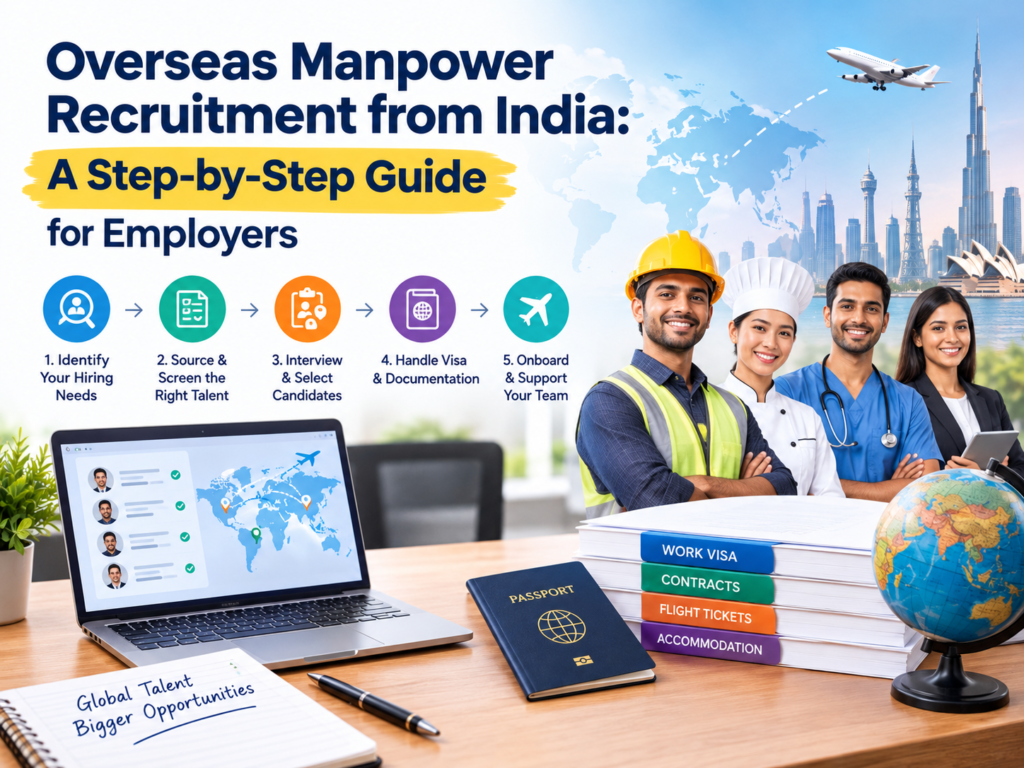
Overseas Manpower Recruitment from India: A Step-by-Step Guide for Employers

Hiring the right workforce is one of the most important decisions for companies managing international operations, expanding into new markets, or executing overseas projects. Whether a business needs engineers for an infrastructure project, IT professionals for a technology team, healthcare workers for a medical facility, or skilled technicians for industrial operations, finding suitable candidates can be challenging without a structured recruitment strategy.

For international employers, India offers access to a diverse talent pool across technical, professional, managerial, and skilled-trade roles. However, successful overseas manpower recruitment from India involves more than sourcing resumes. Employers need to define workforce requirements, evaluate candidates, plan recruitment costs, coordinate interviews, and address employment and immigration requirements in the destination country.

Working with an experienced Overseas Recruitment Agency in India can help businesses organize these activities and identify candidates who match their specific hiring requirements.

In this guide, we explain how employers can recruit manpower from India, choose the right recruitment partner, manage staffing costs, and develop an efficient international hiring process with support from Brightlist Global.

What Is Overseas Manpower Recruitment from India?

Overseas manpower recruitment from India is the process of identifying and hiring Indian professionals, skilled workers, technicians, and other employees for jobs located outside India.

International employers may use this recruitment approach when they need specialized skills, additional project manpower, experienced professionals, or employees for new business operations.

The recruitment process can involve:

  • Understanding workforce requirements and job descriptions
  • Identifying suitable candidates in India
  • Screening resumes and evaluating qualifications
  • Conducting interviews and skill assessments
  • Verifying relevant experience and credentials
  • Coordinating employment offers and joining timelines
  • Managing recruitment-related documentation
  • Addressing applicable overseas employment and immigration requirements

For example, a construction company developing a project in the UAE may require civil engineers, site supervisors, electrical technicians, and project managers. Instead of sourcing every position independently, the company can work with an overseas recruitment agency in India to coordinate candidate sourcing and recruitment activities.

The exact process depends on the industry, destination country, employment arrangement, and requirements of the employer.

Why Do International Companies Recruit Manpower from India?

Companies recruit from India for several business reasons. The suitability of this approach depends on the skills required, candidate availability, compensation expectations, and the conditions of the destination market.

1. Access to a Diverse Talent Pool

India has professionals across industries such as information technology, engineering, healthcare, manufacturing, construction, hospitality, logistics, finance, and business operations.

This diversity allows employers to search for candidates with different qualifications, experience levels, and technical specializations.

2. Recruitment for Specialized Positions

Some projects require niche technical capabilities or industry-specific experience. International employers may expand their sourcing efforts to India when their local candidate pool does not meet those requirements.

For example, a technology company may need cloud engineers, cybersecurity professionals, or experienced software developers for a specialized implementation project.

3. Support for Large-Scale Projects

Construction, manufacturing, infrastructure, healthcare, and hospitality businesses may need multiple employees within a defined period.

Overseas manpower recruitment can help employers coordinate recruitment for different departments and positions through a structured hiring plan.

4. Support for International Expansion

Businesses entering a new market may need employees who can support project delivery, technical operations, management, or service delivery.

A well-planned recruitment strategy helps employers identify suitable candidates while keeping workforce requirements aligned with business objectives.

5. Flexible Recruitment Solutions

Different projects require different employment models. Employers may need permanent employees, contract professionals, temporary workers, or senior specialists.

The appropriate recruitment model depends on the duration of the assignment, the role, applicable employment regulations, and the company’s operational needs.

Step-by-Step Process for Overseas Manpower Recruitment from India

A structured recruitment process helps international employers manage candidate sourcing, evaluate suitability, and coordinate hiring more effectively.

Step 1: Define Your Manpower Requirements

Before contacting recruitment agencies, prepare a detailed list of vacancies and the skills required for each position.

Your workforce plan should include:

  • Job titles and responsibilities
  • Number of employees required
  • Project or workplace location
  • Educational qualifications and certifications
  • Required experience and technical skills
  • Salary range and employment benefits
  • Employment type and contract duration
  • Expected joining dates
  • Any mandatory licensing or language requirements

For example, an employer planning a manufacturing facility may require production engineers, quality inspectors, maintenance technicians, machine operators, and a plant supervisor.

Each position should have its own job description and screening criteria. Clear requirements help recruitment teams focus on suitable candidates instead of forwarding large numbers of unrelated profiles.

Step 2: Choose an Overseas Recruitment Agency in India

The recruitment partner you select can influence candidate quality, communication, recruitment timelines, and the overall hiring experience.

When comparing overseas recruitment agencies in India, evaluate their experience with the relevant industry, sourcing methods, screening procedures, and understanding of international recruitment requirements.

Important questions to ask include:

  • Does the agency understand our industry and job requirements?
  • Can it support the required number of vacancies?
  • How are candidates sourced and screened?
  • What recruitment services are included?
  • How are interviews and candidate feedback coordinated?
  • What are the recruitment fees and payment terms?
  • How are relevant compliance requirements addressed?
  • Can the agency support the required destination market?

Employers should also verify any applicable registration or authorization requirements for recruitment agents conducting overseas recruitment from India.

Brightlist Global offers overseas recruitment solutions for international employers seeking Indian professionals and skilled manpower across multiple industries.

Explore Brightlist Global’s Overseas Recruitment Agency in India services to understand the recruitment support available for business hiring requirements.

Step 3: Prepare a Recruitment Budget

Recruitment costs should be considered before sourcing begins. Employers need to understand the cost of hiring employees and the services included in their recruitment agreement.

Depending on the role and destination, the budget may include:

  • Recruitment and candidate sourcing fees
  • Candidate assessments and background checks
  • Salary and applicable employee benefits
  • Work authorization and immigration-related expenses
  • Medical examinations or professional licensing, where required
  • Travel and relocation costs
  • Accommodation or onboarding support, where applicable
  • Training and project-specific certification expenses

Not every cost applies to every recruitment arrangement. Employers should identify which expenses they will bear and which responsibilities belong to other parties under the agreed employment arrangement.

How Can Companies Find Cost-Effective Recruitment Services?

Businesses searching for Best Discounted Prices for Companies Requiring Staffing & Hiring in India should compare recruitment proposals based on the total service offering.

A lower recruitment fee is not necessarily better value if the proposal does not include the screening, coordination, or support your hiring requirements demand.

To manage recruitment costs:

  1. Finalize job descriptions before candidate sourcing begins.
  2. Establish an approved salary range for each position.
  3. Group related vacancies into a coordinated hiring plan.
  4. Compare the scope and terms of multiple proposals.
  5. Clarify additional charges and replacement conditions.
  6. Track cost per hire and recruitment timelines.
  7. Choose an employment model that fits the actual project requirements.

The goal is to manage recruitment expenditure while maintaining appropriate candidate quality and hiring standards.

Step 4: Source Suitable Candidates from India

Once requirements and budgets are approved, the recruitment team can begin identifying candidates who match the employer’s criteria.

Candidate sourcing methods may include professional networks, job portals, industry contacts, referrals, existing talent databases, and targeted outreach.

The right approach depends on the role and candidate profile.

For example, recruiting a senior engineering manager may require targeted outreach and leadership assessment, while hiring multiple technicians may require a different sourcing and screening strategy.

A recruitment partner should understand the employer’s essential requirements before beginning sourcing.

Step 5: Screen Resumes and Verify Candidate Suitability

Resume screening helps identify candidates whose experience and qualifications align with the vacancy.

However, a resume alone may not establish whether a candidate is suitable for an overseas position.

Employers should assess relevant factors such as:

  • Educational qualifications
  • Professional experience
  • Technical skills and practical knowledge
  • Industry-specific certifications
  • Communication skills relevant to the role
  • Experience with similar projects
  • Availability and notice period
  • Willingness to relocate
  • Eligibility for required professional licensing or employment authorization

Where appropriate, employers can use technical assessments, reference checks, and background verification.

For regulated occupations, verify that the candidate meets the relevant licensing and qualification requirements before confirming the appointment.

Step 6: Coordinate Interviews and Final Selection

Interview coordination can become complicated when international employers and candidates are in different time zones.

A defined interview process helps reduce scheduling delays and ensures that candidates receive clear information about the next steps.

Companies should establish:

  • The number of interview rounds
  • The people responsible for evaluating candidates
  • Technical or practical assessment requirements
  • Feedback deadlines
  • Final approval authority
  • Compensation and offer approval procedures

For bulk recruitment, employers may also consider structured interview schedules to evaluate multiple candidates efficiently.

Once the preferred candidate is selected, confirm compensation, responsibilities, employment conditions, joining timelines, and any outstanding requirements before issuing the final offer.

Step 7: Complete Employment Documentation and Compliance Checks

International recruitment requires careful attention to the laws and procedures applicable in India and the destination country.

Depending on the recruitment arrangement, employers may need to address:

  • Employment contracts
  • Work permits and employment visas
  • Passport and identity documentation
  • Educational and professional qualification verification
  • Background screening
  • Medical examinations, where required
  • Professional licensing and registration
  • Destination-country labor regulations
  • Insurance, payroll, and applicable employee benefits

Indian overseas recruitment requirements should also be considered. The Ministry of External Affairs provides information on the regulatory framework for overseas recruitment, including recruiting-agent registration under applicable provisions of the Emigration Act.

Employers should verify current requirements with the relevant authorities and qualified legal or compliance professionals. Recruitment support should not be treated as a substitute for the necessary government approvals or legal authorization.

Step 8: Coordinate Joining, Relocation, and Onboarding

The recruitment process continues after a candidate accepts an offer.

Employers should establish a joining plan that covers documentation, travel arrangements where applicable, workplace orientation, reporting responsibilities, and role-specific training.

For project-based hiring, onboarding schedules should align with the project start date and operational priorities.

Clear communication helps candidates understand their responsibilities and gives employers a better opportunity to prepare for the employee’s arrival.

Which Industries Can Benefit from Overseas Manpower Recruitment?

Overseas manpower recruitment from India can support businesses across a range of industries. Requirements vary according to the destination market, job responsibilities, and applicable regulations.

IT and Technology

Technology employers may require software developers, cloud engineers, cybersecurity professionals, data specialists, IT managers, and technical architects.

Candidate selection should reflect the technologies, practical experience, and project responsibilities associated with each position.

Engineering and Construction

Infrastructure and construction projects may require civil engineers, mechanical engineers, electrical engineers, site supervisors, project managers, quantity surveyors, and skilled technicians.

Employers should assess technical experience, relevant qualifications, project exposure, and any mandatory destination-country requirements.

Healthcare and Medical Services

Hospitals, clinics, and healthcare organizations may need qualified doctors, nurses, technicians, and other healthcare professionals.

Recruitment planning must account for applicable professional registration, licensing, qualification recognition, and employment requirements.

Manufacturing and Industrial Operations

Manufacturing companies may recruit production engineers, machine operators, maintenance technicians, quality inspectors, industrial supervisors, and plant managers.

Screening should reflect practical skills, workplace safety requirements, technical experience, and operational responsibilities.

Hospitality and Tourism

Hotels, resorts, restaurants, and service businesses may require hotel managers, chefs, front-office professionals, housekeeping supervisors, and food and beverage employees.

Candidate suitability depends on the role, service standards, relevant experience, and language requirements.

Oil and Gas, Logistics, and Energy

These sectors may require engineers, maintenance professionals, logistics coordinators, safety specialists, technicians, and supply chain professionals.

Employers should define any industry-specific certifications, safety training, or technical competencies before recruitment begins.

Brightlist Global supports recruitment requirements across IT, engineering, construction, healthcare, manufacturing, hospitality, oil and gas, logistics, and other sectors.

How to Choose Among Overseas Recruitment Agencies in India

Choosing a recruitment partner involves more than comparing the number of candidates an agency can source.

The right partner should understand the employer’s workforce requirements, communicate clearly, and provide a recruitment process aligned with the roles and destination market.

Use the following criteria when evaluating potential agencies.

Evaluation Factor

What Employers Should Check

Industry experience

Familiarity with the relevant roles and sector

Candidate sourcing

Ability to identify suitable professionals

Screening quality

Clear criteria for assessing candidate suitability

Recruitment capacity

Ability to support the required hiring volume

Service scope

Defined responsibilities and deliverables

Cost transparency

Clear recruitment fees and additional charges

Communication

Regular progress updates and interview coordination

Compliance awareness

Understanding of applicable overseas recruitment requirements

Replacement terms

Written conditions, if replacement support is offered

Reporting

Visibility into sourcing, shortlisting, and hiring progress

Companies searching for the Top HR Consultancy in India for Companies should also distinguish between general HR consulting and recruitment services.

HR consultancies may focus on workforce policies, HR operations, organizational development, or compliance. Recruitment agencies primarily support the identification and hiring of employees, although some providers offer both types of services.

Choose a provider based on the specific outcome your company needs.

How Brightlist Global Supports Overseas Manpower Recruitment

For companies hiring from India, recruitment support should begin with a clear understanding of the business requirement.

Brightlist Global provides overseas recruitment solutions for employers looking to source Indian professionals and skilled manpower for international positions.

Depending on the vacancy and agreed service scope, its recruitment support can include:

  • Understanding employer requirements
  • Candidate sourcing and CV screening
  • Shortlisting suitable candidates
  • Recruitment for professional and technical positions
  • IT and engineering recruitment
  • Healthcare and hospitality recruitment
  • Skilled manpower recruitment
  • Executive search and professional hiring
  • Contract and project-based recruitment
  • Interview and recruitment coordination

The recruitment approach can be tailored according to the employer’s industry, role requirements, experience criteria, hiring volume, and destination market.

Overseas Recruitment for Project-Based Hiring

Businesses managing international projects may need employees with specific skills within a defined timeframe.

For example, an infrastructure company may require engineers and site supervisors, while a manufacturing business may need technical staff for installation, production, and maintenance.

A structured recruitment plan helps employers identify priority roles, define screening requirements, and coordinate hiring around project milestones.

Recruitment Support for Recurring Workforce Requirements

Some businesses have regular international hiring needs across different departments or locations.

For these organizations, a consistent recruitment process can help standardize job descriptions, screening criteria, communication, and recruitment reporting.

Employers can discuss their current and anticipated vacancies with Brightlist Global to explore an appropriate recruitment arrangement.

Learn more about Brightlist Global’s overseas recruitment services.

You can also read How an Overseas Recruitment Agency in India Helps Companies Hire Global Talent for additional information about international recruitment.

Common Mistakes to Avoid in Overseas Manpower Recruitment

Even well-planned hiring campaigns can encounter problems if employers overlook important recruitment steps.

Starting Recruitment Without Clear Requirements

Unclear job descriptions can result in irrelevant applications, repeated shortlisting, and delayed interviews.

Selecting an Agency Only on Price

A low quotation does not guarantee suitable candidates or an efficient recruitment process. Compare the complete service scope and commercial terms.

Ignoring Candidate Availability

Notice periods, relocation willingness, compensation expectations, and joining dates should be discussed early.

Overlooking Destination-Country Requirements

Employment authorization, professional licensing, and immigration procedures can affect whether and when a candidate can begin work.

Delaying Interview Feedback

Slow internal decision-making may cause suitable candidates to lose interest or accept other opportunities.

Failing to Plan Onboarding

Candidates need clear joining instructions, documentation guidance, and workplace information before starting their assignments.

Avoiding these mistakes can make recruitment more organized and reduce preventable delays.

Conclusion

Overseas manpower recruitment from India requires careful planning, effective candidate sourcing, relevant screening, transparent budgeting, and coordination with the employer’s internal teams.

For international businesses, a structured process can help identify suitable professionals, organize recruitment activities, and align hiring with project and operational requirements.

When comparing overseas recruitment agencies in India, evaluate the quality of recruitment support, industry understanding, service scope, communication, and commercial transparency rather than focusing on price alone.

Brightlist Global works with employers seeking overseas recruitment, skilled manpower, professional hiring, and project-based recruitment support.

If your company is planning to hire Indian professionals or skilled workers for international operations, the first step is to define your workforce requirements and discuss them with a suitable recruitment partner.

Planning to hire manpower from India for your overseas business?

Contact Brightlist Global to discuss your vacancies, required skills, hiring volume, destination country, and expected joining timeline.

Website: https://brightlistglobal.com/overseas-recruitment-agency-in-india/

Frequently Asked Questions

1. What is overseas manpower recruitment from India?

Overseas manpower recruitment from India is the process of sourcing and hiring Indian professionals, skilled workers, and other employees for jobs in foreign countries. It may involve candidate sourcing, screening, interviews, verification, recruitment coordination, and support with relevant documentation.

2. What does an overseas recruitment agency in India do?

An overseas recruitment agency helps international employers identify and recruit candidates from India. Depending on the service agreement, it may support workforce planning, candidate sourcing, resume screening, shortlisting, interview coordination, background checks, and recruitment administration.

3. How can companies choose the right overseas recruitment agency?

Companies should evaluate industry experience, candidate sourcing, screening procedures, recruitment capacity, communication, pricing transparency, and understanding of relevant employment requirements. Employers should also verify any applicable registration or authorization requirements.

4. How can businesses reduce overseas recruitment costs?

Businesses can manage recruitment costs by defining requirements clearly, planning vacancies in advance, comparing service proposals, agreeing on transparent commercial terms, and tracking cost per hire. Employers should also account for applicable compensation, documentation, travel, and relocation costs.

5. Which industries can recruit manpower from India?

Industries such as IT, engineering, construction, healthcare, manufacturing, hospitality, oil and gas, logistics, and finance may recruit professionals or skilled workers from India, depending on their requirements and the rules of the destination country.

6. Can overseas recruitment agencies support bulk hiring?

Yes. Depending on their capacity and service scope, recruitment agencies can coordinate sourcing, screening, shortlisting, and interviews for multiple vacancies. Employers should share the number of positions, required skills, budget, and expected timeline before recruitment begins.

7 How can companies contact Brightlist Global for recruitment support?

Companies can visit the Brightlist Global contact page or review its Overseas Recruitment Agency in India service page to discuss their hiring requirements.

How Indian Companies Can Plan Overseas Hiring for Projects in 2026

Planning an international project in 2026 requires more than securing clients, finalizing budgets, and setting deadlines. Companies also need the right people with the skills, qualifications, and experience to deliver the project successfully. Whether a business is expanding into the UAE, managing an overseas construction project, launching a technology operation, or entering a new international market, workforce planning plays a critical role.

For many employers, finding suitable professionals locally can be challenging when a project requires specialized expertise, multiple employees, or a specific hiring timeline. This is why businesses are increasingly exploring international talent sourcing and working with an experienced Overseas Recruitment Agency in India.

India offers a diverse talent pool across IT, engineering, healthcare, construction, manufacturing, hospitality, finance, and other industries. However, hiring professionals for international projects requires a clear understanding of workforce requirements, candidate screening, employment regulations, recruitment budgets, and project timelines.

In this guide, we explain how Indian companies can plan overseas hiring in 2026, manage recruitment costs, choose the right staffing partner, and build teams that support long-term business objectives.

Why Overseas Hiring Matters for Indian Companies in 2026

As businesses expand their operations across borders, workforce requirements are becoming more specialized. A company executing a project in Dubai, for example, may need experienced engineers, project managers, IT specialists, finance professionals, or hospitality staff within a defined period.

Recruiting internationally can help companies access a wider talent pool when suitable skills are difficult to find in their immediate market.

Here are some common situations where overseas hiring can support business growth:

  • Project expansion: Companies entering new international markets may need professionals with relevant technical or industry experience.
  • Specialized skills: Certain projects require specific engineering, IT, healthcare, or management expertise.
  • Bulk recruitment: Large projects may require multiple employees across departments within a limited timeframe.
  • Temporary workforce requirements: Businesses may need additional staff for a few months or for a specific project phase.
  • Leadership hiring: International expansion may require experienced managers and senior professionals who can lead new teams.
  • Operational continuity: Companies need the right workforce in place to meet project milestones and maintain service quality.

A well-planned international recruitment strategy helps employers identify workforce gaps early rather than rushing to fill vacancies when deadlines are approaching.

1. Define Your Overseas Project’s Workforce Requirements

Before approaching recruitment agencies, companies should identify exactly which positions need to be filled. A general request for skilled employees is not enough to build an effective recruitment plan.

Start by preparing a workforce requirement document that includes the following details:

Requirement

What to Define

Project location

Country, city, and work location

Job roles

Engineers, developers, technicians, managers, or other professionals

Number of employees

Total positions required for each role

Qualifications

Educational background, certifications, and technical skills

Experience

Required years of experience and industry exposure

Hiring timeline

Expected joining dates and project milestones

Employment type

Permanent, contract, temporary, or project-based

Budget

Recruitment costs and approved compensation range

For example, an Indian engineering company preparing for a six-month infrastructure project in the UAE might require 10 engineers, four site supervisors, two project managers, and several technical support employees.

Defining these requirements early helps the recruitment team prioritize vacancies, source relevant candidates, and plan interviews more effectively.

Companies with changing workforce requirements can also explore project-based recruitment and RPO services to align recruitment support with their project timelines.

2. Choose the Right Overseas Recruitment Agency in India

Selecting a recruitment partner is one of the most important decisions in international hiring. An agency should understand the employer’s industry, required skills, hiring volume, and destination market.

When evaluating overseas recruitment agencies in India, companies should look beyond the number of resumes an agency can provide. The focus should be on candidate relevance, communication, screening quality, and the ability to coordinate recruitment for international positions.

Consider these factors before making a decision:

Industry-Specific Recruitment Experience

Different projects require different recruitment approaches. An IT company hiring software developers has different requirements from a construction company recruiting site engineers or a healthcare organization hiring qualified medical professionals.

Choose a recruitment partner familiar with your industry and the positions you need to fill.

Candidate Sourcing and Screening

Ask how candidates are sourced, screened, and shortlisted. The recruitment process should evaluate relevant experience, qualifications, technical skills, and suitability for the position.

International Hiring Support

Overseas recruitment involves coordination between employers, candidates, and relevant authorities. Depending on the role and destination, employers may need support with documentation, background screening, interview scheduling, and recruitment coordination.

Transparent Pricing

Recruitment costs should be discussed before the engagement begins. Understand the proposed fee structure, services included, replacement terms if applicable, and any additional charges.

Communication and Reporting

A reliable recruitment partner should provide clear updates on sourcing progress, shortlisted candidates, interview status, and pending requirements.

Businesses looking for an international recruitment partner can explore Brightlist Global’s Overseas Recruitment Services in India to understand the available recruitment solutions.

3. Plan Your Recruitment Budget Before Hiring

Recruitment costs can affect the overall profitability of an international project. Companies should therefore calculate the expected cost of hiring before approving the recruitment plan.

The total cost may include more than employee salaries or recruitment fees.

Depending on the employment arrangement and destination country, the budget may need to account for:

  • Recruitment and candidate sourcing fees
  • Employee salaries and applicable benefits
  • Skills assessments and background verification
  • Work permits, visas, and other required documentation
  • Travel and relocation expenses
  • Accommodation or onboarding support, where applicable
  • Training and project-specific certifications
  • Contingency costs for delayed hiring or additional vacancies

For instance, a company hiring 20 employees for an overseas project should estimate the total workforce cost rather than calculating expenses only on a per-employee salary basis.

How Can Companies Manage Recruitment Costs?

Businesses searching for Best Discounted Prices for Companies Requiring Staffing & Hiring in India should compare recruitment proposals based on the complete service offering rather than choosing the lowest quotation automatically.

A cost-effective recruitment partner should help companies understand the proposed fees, candidate screening process, expected recruitment timeline, and scope of services.

Companies can manage hiring expenses by:

  1. Finalizing job descriptions before recruitment begins.
  2. Prioritizing critical positions and project-dependent roles.
  3. Combining similar vacancies into a coordinated hiring plan.
  4. Considering contract or project-based staffing when appropriate.
  5. Agreeing on clear commercial terms and deliverables.
  6. Tracking recruitment costs against the approved project budget.

The objective is to achieve a suitable balance between recruitment cost, candidate quality, and hiring timelines.

4. Select the Right Hiring Model for Your Project

Not every international project requires permanent employees. The most suitable hiring model depends on the project’s duration, workload, skill requirements, and long-term business plans.

Permanent Recruitment

Permanent recruitment is suitable when companies need employees for ongoing business operations, long-term international expansion, or positions that require continued organizational knowledge.

Contract Staffing

Contract staffing can be appropriate when businesses need professionals for a defined period or temporary operational requirements.

For example, a company implementing a new software system may need additional developers, testers, and technical specialists during the implementation phase.

Project-Based Recruitment

Project-based recruitment is useful when hiring requirements are directly connected to a specific project, milestone, or delivery schedule.

A construction company, for instance, may need additional technical professionals during a particular phase of an overseas development project.

Recruitment Process Outsourcing (RPO)

RPO can help companies that need structured recruitment support across multiple vacancies or ongoing hiring requirements. Depending on the agreed scope, an external recruitment partner can support sourcing, screening, interview coordination, and recruitment administration.

Brightlist Global provides RPO and project-based recruitment solutions for businesses seeking recruitment support aligned with their workforce requirements.

Choosing the right model helps companies avoid unnecessary long-term commitments while maintaining access to the talent needed for project delivery.

5. Identify the Right Talent Across Industries

Overseas hiring requirements vary significantly by industry. A recruitment strategy should reflect the technical, operational, and professional skills required for the project.

Here are some examples of how companies can approach international recruitment in 2026.

IT and Technology

Technology projects may require software developers, cloud specialists, cybersecurity professionals, data analysts, IT project managers, and technical support teams.

Employers should define the required technology stack, certifications, practical experience, and project responsibilities before shortlisting candidates.

Companies seeking technical talent can explore Brightlist Global’s recruitment services for information about its recruitment and staffing solutions.

Engineering and Construction

Infrastructure, industrial, and construction projects may require civil engineers, mechanical engineers, electrical engineers, site supervisors, project managers, and skilled technicians.

Candidates should be evaluated against the project’s technical requirements, relevant experience, certifications, and any mandatory qualifications for the destination country.

Healthcare and Life Sciences

Healthcare organizations may need qualified doctors, nurses, technicians, and other specialized professionals.

Recruitment planning should consider professional licensing, qualification recognition, destination-country registration, and other applicable employment requirements.

Hospitality and Service Industries

Hotels, restaurants, and service businesses may need hospitality managers, chefs, food and beverage professionals, guest service employees, and operational supervisors.

Companies should evaluate relevant industry experience, role-specific skills, language requirements, and the ability to work in the intended environment.

Manufacturing, Logistics, and Industrial Operations

Manufacturing and logistics projects may require production engineers, quality specialists, maintenance technicians, warehouse professionals, supply chain specialists, and operational managers.

The hiring plan should reflect shift requirements, technical competencies, workplace safety expectations, and project workload.

Working with a recruitment partner that understands these industry differences can help companies develop more focused candidate sourcing and screening strategies.

6. Prepare for International Employment Regulations

Hiring employees across borders involves legal and administrative responsibilities. Companies should confirm the applicable requirements before making employment commitments or arranging international deployment.

Depending on the destination and employment arrangement, these requirements may include:

  • Valid work authorization and employment visas
  • Professional licensing or qualification recognition
  • Employment contracts and applicable labor laws
  • Background verification and document authentication
  • Medical examinations, where required
  • Insurance and employee benefits
  • Tax, payroll, and social security obligations
  • Relocation and onboarding documentation

Indian companies recruiting candidates for employment abroad should also understand the relevant Indian overseas recruitment requirements. Recruitment agents and employers should verify the applicable rules under Indian law, including registration and authorization requirements where relevant, alongside the destination country’s regulations.

For example, a company recruiting healthcare professionals for an overseas assignment may need to verify professional credentials and licensing requirements before confirming deployment.

It is advisable to involve qualified legal or compliance professionals when the employment arrangement or destination regulations require specialist guidance.

7. Create a Recruitment Timeline That Matches Project Milestones

Hiring delays can affect project delivery, employee productivity, and operating costs. Companies should work backward from the expected project start date to create a realistic recruitment schedule.

A sample planning framework is outlined below. The actual timeline will depend on role complexity, candidate availability, hiring volume, and destination-country requirements.

Recruitment Stage

Key Activities

Initial planning

Finalize vacancies, skills, budgets, and hiring priorities

Candidate sourcing

Identify and approach relevant professionals

Screening

Review qualifications, experience, and role suitability

Interviews

Coordinate employer interviews and assessments

Selection

Finalize candidates and agree on employment terms

Documentation

Complete applicable verification and authorization steps

Onboarding

Prepare employees for joining and project deployment

For large-scale recruitment, several stages may run simultaneously. For example, candidate sourcing for multiple roles can begin while interview schedules are being finalized for earlier shortlisted candidates.

Regular progress reviews between the company and recruitment partner can help identify bottlenecks before they affect the project schedule.

8. Measure Recruitment Performance Using Relevant KPIs

A successful overseas hiring strategy should be measured by more than the number of candidates sourced.

Companies should track recruitment performance to understand whether the process is meeting project requirements and using the available budget effectively.

Useful recruitment KPIs include:

  • Time to shortlist: How quickly suitable candidate profiles are identified.
  • Time to hire: The time taken to complete the hiring process.
  • Interview-to-selection ratio: How effectively shortlisted candidates match employer expectations.
  • Offer acceptance rate: The percentage of offers accepted by selected candidates.
  • Cost per hire: Total recruitment expenditure divided by the number of employees hired.
  • Joining rate: The proportion of selected candidates who actually join.
  • Retention and performance: Whether employees remain in their roles and meet relevant expectations over time.

These metrics help businesses identify gaps in job descriptions, sourcing strategies, screening criteria, and recruitment coordination.

For example, if a company receives many candidate profiles but very few candidates progress to interviews, the recruitment team may need to review the required experience, skills, or candidate screening criteria.

A consistent reporting process makes it easier to improve hiring decisions during the project and for future international recruitment requirements.

9. How to Choose the Best Placement Agency in India for Overseas Hiring

Companies comparing options for the Best Placement Agency in India should assess the agency’s suitability for their specific hiring requirements.

The right partner should be able to explain its recruitment process, understand the employer’s business needs, and provide clear information about its services and commercial terms.

Before finalizing an agency, ask the following questions:

  1. Does the agency understand our industry and the positions we need to fill?
  2. Can it support the required hiring volume and project timeline?
  3. How does it source, screen, and shortlist candidates?
  4. What recruitment services are included in the proposal?
  5. How are recruitment progress and candidate feedback communicated?
  6. What are the fees, payment terms, and applicable replacement conditions?
  7. How are relevant international employment and compliance requirements addressed?

Employers should also review the agency’s experience, service scope, communication standards, and ability to support their destination market.

Brightlist Global offers recruitment services for businesses in India and Dubai, including overseas recruitment, manpower recruitment, contract staffing, executive search, and RPO. Companies can review the Brightlist Global recruitment services page to explore the available solutions.

10. Why Companies Can Consider Brightlist Global for Overseas Hiring

When companies plan international projects, they need a recruitment approach that reflects their workforce requirements rather than a generic hiring process.

Brightlist Global supports businesses seeking recruitment and staffing solutions across India, Dubai, and international markets. Its recruitment services cover multiple industries, including IT, healthcare, engineering, construction, hospitality, manufacturing, and finance.

Depending on the employer’s requirements, recruitment support may include:

  • Overseas recruitment for international workforce requirements
  • Manpower recruitment for skilled and operational roles
  • IT recruitment for technical and technology positions
  • Contract staffing for defined workforce requirements
  • Project-based recruitment for temporary or project-specific roles
  • Executive search for senior and leadership positions
  • Recruitment Process Outsourcing for structured hiring support
  • Background screening and recruitment coordination

Companies can discuss their project scope, number of vacancies, required skills, hiring location, and expected timeline with the recruitment team to identify an appropriate recruitment approach.

To learn more, visit Brightlist Global’s Overseas Recruitment Agency in India page.

Businesses hiring for hospitality positions in Dubai can also explore Hospitality Recruitment Consultants in Dubai for industry-specific recruitment information.

Common Mistakes to Avoid When Planning Overseas Recruitment

Even companies with clearly defined projects can experience hiring difficulties when recruitment planning begins too late or lacks sufficient detail.

Avoid these common mistakes:

Starting Recruitment Too Late

Waiting until the project start date is close can limit the time available for sourcing, screening, interviews, and required documentation.

Using Generic Job Descriptions

Vague job descriptions can attract unsuitable applicants and delay shortlisting. Clearly define the skills, qualifications, responsibilities, and experience required.

Choosing an Agency Based Only on Price

The lowest recruitment quotation may not offer the service scope or screening quality your project needs. Compare the overall proposal and commercial terms before deciding.

Ignoring Compliance Requirements

Employment authorization, professional licensing, and local labor requirements should be considered early in the recruitment process.

Failing to Track Recruitment Progress

Without regular reporting, companies may not identify sourcing gaps, delayed interviews, or candidate drop-offs until they affect the project schedule.

Hiring Without a Defined Workforce Plan

Recruiting too many or too few employees can affect project costs and operational efficiency. Align recruitment numbers with actual project responsibilities and milestones.

Conclusion

Successful overseas hiring starts with understanding the project’s workforce requirements, establishing a realistic recruitment budget, selecting the right hiring model, and preparing for international employment requirements.

For Indian companies planning international expansion or managing overseas projects in 2026, a structured recruitment strategy can help improve candidate sourcing, coordinate hiring activities, and support project delivery.

Choosing among overseas recruitment agencies in India should involve evaluating candidate quality, industry expertise, communication, service scope, and transparent commercial terms rather than focusing on price alone.

Brightlist Global works with businesses seeking overseas recruitment, staffing, project-based hiring, and recruitment support across multiple industries.

If your company is planning to hire professionals from India for an international project, contact Brightlist Global to discuss your hiring requirements.

Website: https://brightlistglobal.com/

Frequently Asked Questions

1. How can Indian companies hire employees for overseas projects in 2026?

Indian companies can begin by defining job roles, required skills, workforce numbers, project timelines, and budgets. They can then work with a suitable overseas recruitment agency in India to source candidates, screen profiles, coordinate interviews, and manage the recruitment process in line with applicable employment requirements.

2. What does an overseas recruitment agency in India do?

An overseas recruitment agency in India helps employers source and recruit candidates for international positions. Depending on the agreed services, support can include candidate sourcing, CV screening, shortlisting, interview coordination, background screening, and recruitment-related documentation coordination.

3. Can recruitment agencies support bulk hiring for international projects?

Yes. Recruitment agencies can support bulk hiring by coordinating candidate sourcing, screening, shortlisting, and interviews across multiple vacancies. The recruitment approach depends on the hiring volume, role requirements, candidate availability, and project timeline.

4. How can companies reduce overseas recruitment costs?

Companies can manage recruitment costs by finalizing job descriptions, prioritizing critical vacancies, comparing transparent service proposals, selecting the right hiring model, and tracking cost per hire. Visa, relocation, compensation, and other applicable employment costs should also be considered when preparing the overall budget.

5. What is the difference between overseas recruitment and project-based recruitment?

Overseas recruitment focuses on hiring candidates for international employment opportunities. Project-based recruitment focuses on filling roles linked to a particular project or defined period. A company may use both approaches when it needs professionals from India for a temporary overseas assignment.

6. Which industries can benefit from overseas recruitment services?

IT, engineering, construction, healthcare, manufacturing, hospitality, logistics, finance, and other industries can benefit from overseas recruitment when they require specialized skills, additional manpower, or access to a broader talent pool.

7. How should companies compare overseas recruitment agencies in India?

Companies should compare industry experience, sourcing methods, screening procedures, communication, international recruitment knowledge, service scope, pricing, and compliance processes. They should also confirm whether the agency can support the required hiring volume and destination market.
Choosing-Indias-Best-Overseas-Recruitment-Agency.

How to Choose the Best Overseas Recruitment Agency in India in 2026

Finding the right talent is one of the biggest challenges for businesses that want to grow, expand into new markets, or manage increasing workloads. Hiring qualified employees requires time, resources, and a clear understanding of the skills a business needs. For companies looking to recruit talent for international opportunities, choosing the right recruitment partner can make the process more organised and efficient.

The Best Overseas Recruitment Agency in India in 2026 should understand employer requirements, candidate expectations, industry demands, and international hiring processes. Whether a company needs skilled professionals, technical employees, hospitality staff, or workforce support for a large project, the right recruitment partner can help simplify talent acquisition.

Brightlist Global supports businesses looking for recruitment solutions aligned with their workforce requirements. In this guide, we explore what companies should consider when choosing an overseas recruitment agency and how the right partner can support their hiring goals.

What Is an Overseas Recruitment Agency?

An Overseas Recruitment Agency in India helps connect employers with suitable candidates for employment opportunities in other countries. Depending on its services and authorisations, an agency may assist with candidate sourcing, screening, interviews, recruitment coordination, and documentation.

For international employers, recruitment agencies can provide access to talent pools in India without requiring the internal HR team to manage every stage of candidate sourcing independently.

Common recruitment requirements may include:

  • Skilled and semi-skilled workforce recruitment
  • Technical and engineering professionals
  • IT and other specialised professionals
  • Hospitality and hotel industry staff
  • Construction and manufacturing workers
  • Bulk recruitment for projects and business expansion

The services required will depend on the employer’s industry, hiring volume, job specifications, and destination country.

Why Choosing the Right Overseas Recruitment Agency Matters

Hiring the wrong candidate can lead to additional recruitment costs, operational delays, and increased pressure on existing employees. A suitable recruitment partner helps businesses establish a clearer hiring process and identify candidates who meet their requirements. Here are some important benefits of choosing the right agency.

1. Access to a Wider Talent Pool

Recruitment agencies can help businesses reach candidates with different qualifications, experience levels, and professional backgrounds. This can be particularly useful when an employer needs specialised skills or multiple employees within a limited timeframe.

2. A More Organised Recruitment Process

Managing job advertisements, applications, initial screening, interviews, and candidate communication internally can be time-consuming. An experienced recruitment partner can coordinate these activities according to the agreed recruitment process.

3. Support for Bulk Hiring Requirements

Companies working on construction projects, hospitality operations, manufacturing activities, or business expansion may need to recruit several employees at once. Recruitment support can help organise candidate sourcing and selection for different positions.

4. Better Alignment Between Candidates and Job Requirements

Recruitment should focus on more than the number of applications received. Relevant experience, technical skills, qualifications, communication abilities, and job expectations must also be considered. A structured selection process can help employers identify candidates who are better aligned with their roles.

7 Factors to Consider When Choosing the Best Overseas Recruitment Agency in India in 2026

Before partnering with an agency, companies should evaluate its capabilities, experience, recruitment process, and suitability for their hiring requirements.

1. Industry Experience and Recruitment Expertise

Start by checking whether the agency understands your industry and the positions you need to fill. Recruiting hospitality professionals, software engineers, construction workers, and manufacturing technicians requires different screening criteria. Ask about its experience with similar job roles, candidate sourcing methods, and recruitment volumes.

An agency with relevant industry knowledge may be better equipped to understand job specifications and identify suitable candidates.

2. Understanding of International Recruitment Requirements

Overseas hiring involves more than identifying qualified candidates. Employers may need to consider employment contracts, work authorisations, destination-country labour requirements, and applicable Indian recruitment regulations.

Choose a recruitment partner that understands the requirements relevant to your hiring arrangement and can clarify which responsibilities belong to the agency, employer, and candidate.

For overseas recruitment from India, verify the applicable registration and authorisation requirements. The Ministry of External Affairs provides official information about recruiting agents and overseas employment procedures.

3. Transparent Recruitment Pricing

Recruitment budgets vary according to job roles, candidate volumes, sourcing complexity, screening requirements, and service scope. Before signing an agreement, request a clear breakdown of the proposed charges.

Companies comparing agencies should check:

  • Recruitment and service fees
  • Candidate sourcing and screening costs
  • Any additional charges for bulk hiring
  • Replacement terms, if offered
  • Payment milestones and contract conditions

Businesses searching for Best Discounted Prices for Companies Requiring Staffing & Hiring in India should compare the overall value of each proposal instead of selecting an agency based only on the lowest quoted price.

A transparent quotation helps companies plan recruitment expenditure and understand exactly which services are included.

4. Candidate Screening and Selection Methods

A recruitment agency should follow a selection process suited to the position being filled. Depending on the role, this may include reviewing CVs, checking qualifications, conducting preliminary interviews, assessing technical skills, and verifying relevant employment details.

Employers should discuss the screening process before recruitment begins. Clearly defined selection criteria can help reduce unsuitable applications and improve communication between the company and its recruitment partner.

5. Communication and Recruitment Coordination

Recruitment projects often involve multiple stakeholders, including HR managers, department heads, recruitment consultants, and candidates.

An effective recruitment partner should provide clear updates about candidate availability, interview schedules, selection progress, and pending requirements.

Before engaging an agency, clarify who will manage communication, how often updates will be shared, and how recruitment challenges will be addressed.

6. Ability to Handle Different Hiring Volumes

Some companies need one or two specialised employees, while others require a larger workforce for new projects or operational expansion.

Discuss your expected hiring volume, required joining timelines, job locations, and workforce categories. Ask the agency how it plans to manage candidate sourcing and screening for your specific requirements.

The right recruitment partner should propose a realistic process based on the availability of suitable candidates rather than making unsupported promises.

7. Reputation, References, and Service Transparency

Before finalising an agency, review its website, service information, professional background, and available client references. Ask for examples of relevant recruitment assignments where appropriate.

Businesses should also confirm the agency’s legal identity, contractual terms, and any registration or licence requirements applicable to the recruitment services being provided. These checks help establish whether the agency is a suitable partner for the company’s recruitment needs.

Overseas Talent Recruiters: How They Support Business Hiring

Overseas talent recruiters help employers identify candidates for international positions by coordinating different stages of the recruitment process.

Depending on the agreed scope, their responsibilities may include:

  • Understanding job descriptions and candidate requirements
  • Sourcing candidates through relevant recruitment channels
  • Reviewing applications and shortlisting suitable profiles
  • Coordinating interviews with employers
  • Communicating selection decisions and candidate availability
  • Supporting recruitment documentation and onboarding coordination

For businesses hiring across multiple departments or locations, this coordination can make the recruitment process easier to manage.

However, responsibilities vary between agencies. Employers should confirm the exact services included in the agreement before beginning a recruitment assignment.

Best Placement Agency for Companies: What Should Employers Look For?

Companies searching for the Best Placement Agency for Companies should look beyond the number of CVs an agency can provide. Recruitment quality depends on how well candidates match the employer’s requirements.

A suitable placement partner should understand the job responsibilities, required qualifications, expected experience, compensation range, and workplace expectations.

Employers should also consider the following questions:

  • Does the agency understand our industry and job roles?
  • Can it explain its candidate screening process?
  • Are its fees and contract terms transparent?
  • Does it provide regular recruitment updates?
  • Can it support our expected hiring volume?
  • Are its services appropriate for the country and type of recruitment involved?

Comparing agencies against the same criteria makes it easier to evaluate proposals fairly and select a partner that aligns with business objectives.

Top HR Consultancy in India for Companies: How to Compare Your Options

A company looking for the Top HR Consultancy in India For Companies may need support beyond overseas recruitment. Depending on its requirements, it may also consider domestic hiring, talent acquisition, staffing coordination, or other HR-related services.

Before selecting a consultancy, define the business problem you want to solve.

For example, a company opening a new office may need professional recruitment support, while a manufacturer expanding production may require multiple technical and operational employees.

Compare potential providers based on:

Service coverage: Confirm whether the consultancy offers the specific recruitment or staffing services you need.

Industry understanding: Check whether it understands your business sector and the profiles you want to hire.

Recruitment process: Review its sourcing, screening, interview coordination, and reporting methods.

Commercial terms: Understand the fees, payment structure, service commitments, and any applicable replacement policy.

Scalability: Consider whether the provider can support future recruitment requirements as your company grows.

A clear evaluation process helps businesses select a recruitment partner based on suitability rather than marketing claims alone.

How to Find Cost-Effective Staffing and Hiring Solutions in India

Recruitment expenses can increase when companies repeatedly advertise vacancies, conduct unsuitable interviews, or restart the hiring process because candidates do not meet the required criteria.

A well-planned recruitment strategy can help businesses manage these expenses.

Define the Role Before Starting Recruitment

Prepare a clear job description that includes responsibilities, required skills, experience, compensation, work location, and reporting structure. Clear expectations help recruiters identify relevant candidates more efficiently.

Establish a Realistic Hiring Budget

Set a recruitment budget based on the number of positions, job complexity, hiring urgency, and expected service requirements. Ask agencies to explain their pricing and identify any additional charges before work begins.

Consolidate Bulk Hiring Requirements

Where practical, group similar vacancies into one recruitment plan. This can help the recruitment team understand the overall requirement and organise sourcing and interview schedules more effectively.

Measure Recruitment Outcomes

Track indicators such as time to fill, interview-to-selection ratio, joining rate, candidate suitability, and recruitment cost per hire. Reviewing these measures can help companies understand which recruitment methods deliver value.

Cost-effective hiring does not necessarily mean choosing the cheapest provider. The objective is to balance recruitment expenditure with candidate quality, process efficiency, and business requirements.

Why Consider Brightlist Global for Recruitment Support?

Brightlist Global provides a recruitment-focused option for businesses exploring staffing and hiring support. Companies considering its services can discuss their workforce requirements, target positions, hiring volumes, and expected timelines to determine whether the proposed solution is suitable.

When evaluating Brightlist Global or any other recruitment provider, employers should clarify the scope of services, recruitment approach, commercial terms, and responsibilities involved in the assignment.

A productive recruitment partnership begins with a shared understanding of the roles to be filled, the qualifications required, and the business outcomes expected.

Businesses can explore the Brightlist Global overseas recruitment service page to learn more and enquire about their recruitment requirements.

Common Mistakes to Avoid When Selecting a Recruitment Agency

Even companies with established HR teams can face recruitment challenges when they select an agency without evaluating its suitability.

Avoid these common mistakes:

  • Choosing an agency based entirely on the lowest price.
  • Providing incomplete or unclear job descriptions.
  • Failing to confirm the full scope of recruitment services.
  • Overlooking applicable registration and legal requirements.
  • Expecting guaranteed results without discussing realistic timelines.
  • Ignoring communication, reporting, and candidate-screening procedures.
  • Signing an agreement without reviewing fees, responsibilities, and service conditions.

Taking time to evaluate these factors can help businesses make more informed recruitment decisions.

Conclusion

Choosing the Best Overseas Recruitment Agency in India in 2026 requires careful consideration of industry expertise, candidate screening, international recruitment requirements, pricing transparency, and communication.

Whether your company needs specialised professionals, skilled workers, hospitality employees, or support for bulk hiring, a clearly defined recruitment strategy can make talent acquisition more manageable.

Brightlist Global is an option businesses can explore when assessing recruitment support for their workforce needs. Define your hiring objectives, compare suitable providers, and discuss the recruitment process before deciding on a long-term partnership.

The right recruitment approach should help your company identify suitable talent while keeping hiring decisions aligned with operational needs and budget expectations.

Frequently Asked Questions(FAQS)

1. How do I choose the best overseas recruitment agency in India in 2026?

Evaluate the agency's industry experience, candidate screening process, recruitment services, pricing transparency, communication practices, and applicable registrations. Choose a provider that understands your hiring requirements and clearly explains its scope of work.

2. What services does an overseas recruitment agency in India provide?

Depending on its service offering, an agency may support candidate sourcing, CV screening, shortlisting, interview coordination, recruitment documentation, and onboarding coordination for international hiring.

3. How can companies find cost-effective staffing and hiring services in India?

Companies can compare detailed quotations, define job requirements clearly, consolidate similar vacancies, and evaluate recruitment outcomes. Consider overall service quality and suitability rather than comparing prices alone.

4. What should companies check before hiring overseas talent recruiters?

Review the recruiters' relevant experience, sourcing methods, candidate assessment procedures, communication practices, contract terms, and any registration or authorisation requirements that apply to the proposed recruitment activity.

5. How can a placement agency help companies hire suitable employees?

A placement agency can help source candidates, review applications, shortlist profiles, and coordinate interviews according to the employer's requirements. The exact services depend on the agreement.

6. Why should businesses consider Brightlist Global?

Businesses can explore Brightlist Global's recruitment services and discuss their hiring requirements, expected workforce size, job profiles, and recruitment timelines to determine whether its offering meets their needs.
overseas-Recuritment-agency-in-india

How an Overseas Recruitment Agency in India Helps Companies Hire Global Talent

In today’s competitive business environment, companies are no longer limited to hiring talent from their local markets. Organisations across industries are increasingly looking beyond borders to find skilled professionals, experienced specialists, and reliable employees. However, international hiring can involve challenges such as talent sourcing, candidate screening, documentation, compliance, cultural differences, and relocation support.

This is where an Overseas Recruitment Agency in India can make a significant difference.

India has a large and diverse talent pool across industries such as IT, healthcare, engineering, hospitality, construction, manufacturing, logistics, and more. A professional recruitment partner can help companies connect with suitable candidates while simplifying the overall hiring process.

Brightlist Global supports businesses in identifying and connecting with qualified professionals for overseas employment opportunities. By understanding employer requirements and candidate capabilities, a recruitment agency can help make global hiring more organised, efficient, and focused.

What Is an Overseas Recruitment Agency?

An overseas recruitment agency in India helps international employers find and recruit suitable candidates from India for job opportunities in other countries.

These agencies act as a bridge between employers and job seekers. Their responsibilities may include:

  • Understanding workforce requirements
  • Sourcing suitable candidates
  • Screening applications and resumes
  • Conducting initial interviews
  • Verifying candidate qualifications
  • Coordinating interviews with employers
  • Assisting with recruitment documentation
  • Supporting communication between employers and candidates

The objective is to make international recruitment easier for companies while helping candidates access relevant overseas job opportunities.

Why Are Companies Looking for Global Talent?

Businesses hire internationally for several reasons. In some industries, finding professionals with specific technical skills or experience can be challenging within a limited geographical area.

Global recruitment allows companies to access a broader talent pool.

Hiring Requirement

How Global Recruitment Can Help

Skill shortages

Access professionals from a wider talent pool

Business expansion

Build teams in new markets

Specialised roles

Find candidates with specific experience

Workforce growth

Recruit multiple employees efficiently

Industry expertise

Access professionals with relevant qualifications

Diverse teams

Bring different experiences and perspectives into the organisation

Working with an experienced overseas recruitment agency in India can help businesses streamline this process and focus on candidates who match their hiring requirements.

How an Overseas Recruitment Agency in India Supports Employers

1. Understanding the Company’s Hiring Requirements

Every company has different workforce requirements. Before beginning the recruitment process, a professional agency works to understand important details such as:

  • Job roles and responsibilities
  • Required qualifications
  • Technical or industry-specific skills
  • Years of experience
  • Number of vacancies
  • Preferred candidate profiles
  • Location of employment

This initial understanding helps create a more focused recruitment strategy.

For example, a healthcare organisation may require experienced nursing professionals, while a construction company may be searching for engineers, project managers, technicians, or skilled workers.

A well-defined requirement helps the recruitment process move in the right direction from the beginning.

2. Access to a Wider Talent Pool

One of the major advantages of working with an overseas recruitment agency in India is access to a large and diverse candidate network.

India has professionals working across a wide range of industries, including:

Industry

Common Overseas Hiring Roles

IT & Technology

Software developers, data analysts, IT professionals

Healthcare

Nurses, doctors, technicians, healthcare support staff

Engineering

Mechanical, civil, electrical, and project engineers

Hospitality

Chefs, hotel staff, restaurant professionals

Construction

Engineers, supervisors, technicians, skilled workers

Manufacturing

Production specialists, quality professionals, operators

Logistics

Warehouse professionals, supply chain specialists

Education

Teachers, trainers, and academic professionals

Recruitment agencies use different sourcing methods to identify suitable candidates and build a relevant talent pipeline for employers.

3. Candidate Screening and Shortlisting

Reviewing hundreds or thousands of job applications can take significant time and resources.

An overseas recruitment agency can help reduce this workload by conducting an initial screening process. Depending on the role and recruitment requirements, the agency may review:

  • Educational qualifications
  • Professional experience
  • Relevant skills
  • Resume information
  • Communication abilities
  • Role suitability

This allows employers to focus more on shortlisted candidates who closely match the job requirements.

At Brightlist Global, the focus is on understanding both employer expectations and candidate profiles to support a more structured recruitment process.

4. Saving Time in the Hiring Process

Recruitment can be time-consuming, particularly when companies need to hire multiple employees or recruit for specialised positions.

An agency can support different stages of the hiring journey, from candidate sourcing to interview coordination.

Recruitment Stage

Support from a Recruitment Agency

Requirement analysis

Understand job roles and hiring needs

Candidate sourcing

Identify potential candidates

Resume screening

Filter profiles based on requirements

Initial assessment

Evaluate candidate suitability

Shortlisting

Present relevant candidate profiles

Interview coordination

Schedule communication between candidates and employers

Documentation support

Assist with recruitment-related processes

By outsourcing parts of the recruitment process, companies can save internal resources and concentrate on their core business operations.

5. Support for Bulk and Volume Hiring

Some companies need to recruit a large number of employees within a specific timeframe. This is common in industries such as construction, hospitality, manufacturing, healthcare, and logistics.

An experienced overseas recruitment agency in India can help manage large-scale recruitment campaigns by organising candidate sourcing, screening, shortlisting, and interview coordination.

This can be particularly useful when companies are:

  • Opening new facilities
  • Expanding into new markets
  • Starting large projects
  • Increasing operational capacity
  • Replacing or expanding their workforce

A structured recruitment approach can help companies manage volume hiring more efficiently.

6. Industry-Specific Recruitment Expertise

Different industries require different types of professionals. The skills needed for an IT role are very different from those required in healthcare, hospitality, or engineering.

Recruitment agencies with industry knowledge can better understand:

  • Required technical skills
  • Relevant experience
  • Industry terminology
  • Job-specific qualifications
  • Candidate expectations

This can improve the quality of candidate shortlisting and reduce the chances of unsuitable profiles reaching the final interview stage.

7. Helping Companies Improve Recruitment Efficiency

Hiring the wrong candidate can result in additional costs, delays, and repeated recruitment efforts.

A structured recruitment process can help companies improve efficiency by focusing on relevant candidates from the beginning.

An overseas recruitment partner can assist businesses with:

  • Creating focused candidate searches
  • Building talent pipelines
  • Reducing manual resume screening
  • Coordinating recruitment activities
  • Improving communication during the hiring process

This makes recruitment more organised, particularly when companies are managing international hiring requirements.

Why Choose Brightlist Global for Overseas Recruitment?

When companies are hiring internationally, choosing the right recruitment partner is an important decision.

Brightlist Global aims to support employers by understanding their workforce requirements and connecting them with relevant talent. As an overseas staffing agency, a professional recruitment approach can help simplify the process of sourcing, screening, and shortlisting candidates for overseas opportunities.

The recruitment process focuses on key factors such as:

  • Understanding employer requirements
  • Identifying suitable candidates
  • Screening relevant profiles
  • Supporting efficient communication
  • Coordinating the recruitment process

Businesses looking for an overseas recruitment agency in India or a reliable overseas staffing agency should consider factors such as industry experience, recruitment processes, candidate sourcing capabilities, communication, and an understanding of international hiring requirements.

How Overseas Recruitment Agencies Help Candidates

While companies benefit from access to a wider talent pool, candidates can also receive support during the recruitment process.

A recruitment agency may help candidates understand:

  • Available job opportunities
  • Job requirements
  • Required qualifications
  • Recruitment procedures
  • Interview expectations
  • Documentation requirements

This creates a more organised connection between employers and professionals seeking international career opportunities.

Overseas Recruitment Agency in India vs Traditional Recruitment

Factor

Overseas Recruitment Agency in India

Traditional Local Recruitment

Hiring market

International opportunities

Primarily local or domestic

Talent sourcing

Wider and cross-border talent pool

Limited to targeted local markets

Recruitment requirements

May involve international employment processes

Usually focused on domestic hiring

Candidate coordination

Can involve multiple locations and employers

Generally simpler geographical coordination

Workforce requirements

Suitable for global hiring needs

Suitable for local hiring needs

The right approach depends on the company’s hiring goals, industry, location, and workforce requirements.

How to Choose Among the Top Recruitment Agencies in India

Companies searching for the top recruitment agencies in India should look beyond simply receiving a list of candidate profiles. The right recruitment partner should understand the organisation’s business requirements and hiring objectives.

Here are some important factors to consider:

Industry Experience

Choose an agency that understands your industry and the skills required for specific roles.

Recruitment Process

Understand how the agency sources, screens, and shortlists candidates.

Communication

Clear communication is important throughout the recruitment process, especially when employers and candidates are located in different countries.

Talent Network

A strong candidate network can help agencies identify suitable professionals more efficiently.

Understanding of International Hiring

For overseas recruitment, the agency should understand the additional coordination involved in international employment opportunities.

Key Benefits of Partnering with an Overseas Recruitment Agency

Here is a quick overview of how businesses can benefit:

Benefit

How It Helps Employers

Wider talent access

Connect with candidates beyond local markets

Time savings

Reduce the effort involved in sourcing and screening

Recruitment support

Get assistance throughout different hiring stages

Industry-focused hiring

Find professionals with relevant skills

Bulk recruitment support

Manage multiple vacancies efficiently

Better candidate shortlisting

Focus on profiles aligned with job requirements

Streamlined coordination

Improve communication between employers and candidates

IT managers and technology professionals based on their hiring requirements.

The Growing Importance of Global Recruitment

As businesses expand internationally and workforce requirements continue to evolve, companies are increasingly exploring new ways to access skilled professionals.

An overseas recruitment agency in India can support this process by helping employers connect with a diverse pool of candidates across multiple industries.

For companies planning international expansion, hiring for specialised roles, or managing large-scale workforce requirements, working with a professional recruitment partner can make the hiring journey more structured and manageable.

Conclusion

Hiring global talent can create new opportunities for companies looking to build skilled, diverse, and capable teams. However, international recruitment requires careful planning, effective candidate sourcing, screening, and coordination.

Partnering with an overseas recruitment agency in India can help businesses simplify these processes and gain access to a wider pool of potential candidates. From understanding workforce requirements to sourcing and shortlisting relevant professionals, a recruitment partner can support companies throughout the hiring journey.

For businesses searching for reliable support among the top recruitment agencies in India, Brightlist Global offers a professional approach to understanding recruitment needs and connecting employers with suitable talent for overseas opportunities.

By choosing the right recruitment partner, companies can make their global hiring process more efficient, organised, and focused on finding professionals who align with their workforce requirements.

Frequently Added Questions

An overseas recruitment agency in India helps international employers source, screen, shortlist, and connect with suitable candidates from India for overseas job opportunities.

The agency can support employers with candidate sourcing, resume screening, initial assessments, shortlisting, interview coordination, and recruitment-related communication.

Industries such as IT, healthcare, engineering, construction, hospitality, manufacturing, logistics, and education can benefit from overseas recruitment services, depending on their workforce requirements.

When comparing the top recruitment agencies in India, consider their industry knowledge, recruitment process, candidate network, communication practices, and experience in handling your hiring requirements.

Yes, recruitment agencies can assist companies that need to hire multiple employees by managing sourcing, screening, shortlisting, and interview coordination.

Brightlist Global supports businesses by understanding their hiring requirements and helping them connect with relevant candidates for overseas employment opportunities through a structured recruitment approach.