
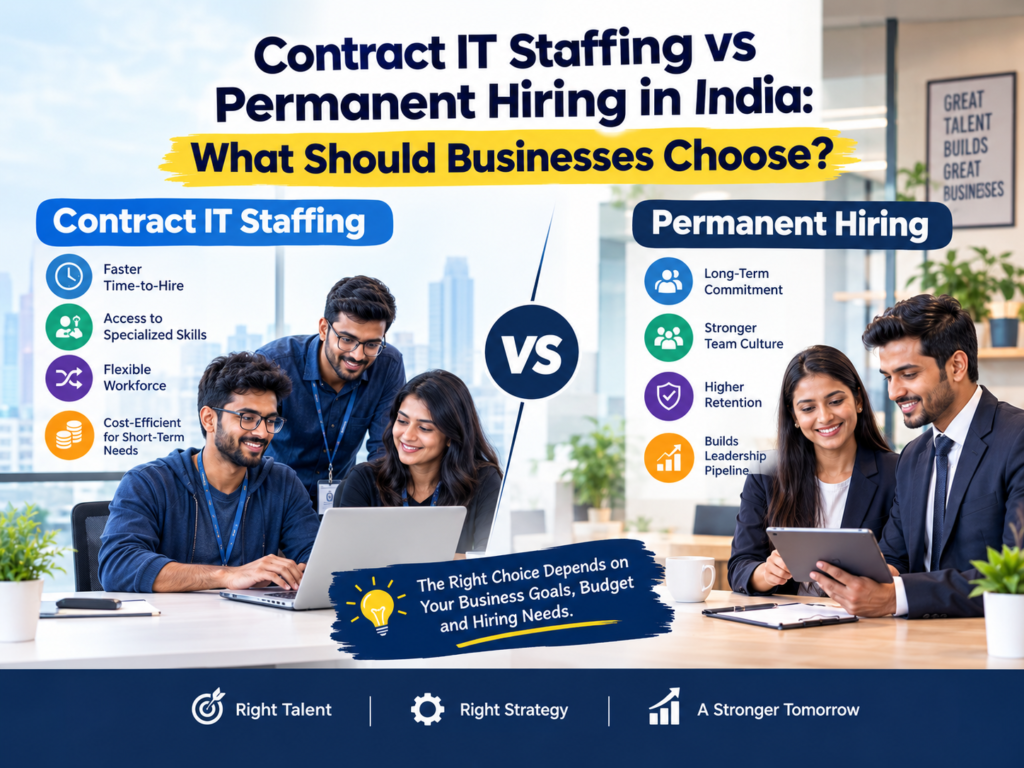
Hiring the right IT professionals is essential for businesses that want to improve productivity, complete technology projects, and stay competitive. However, one important decision companies face is whether to hire employees permanently or choose contract IT staffing.
Both hiring models offer advantages, but the right option depends on your business goals, project timelines, budget, and technical requirements. A company developing a long-term software product may need permanent developers, while a business implementing a cloud migration project may benefit from contract professionals with specialized skills.
Understanding Contract IT Staffing vs Permanent Hiring in India can help employers make informed recruitment decisions, manage workforce costs, and access the technical expertise they need.
In this guide, we compare both hiring models, explain their benefits and limitations, and help businesses choose the right IT staffing solution.
What Is Contract IT Staffing?
Contract IT staffing is a hiring model in which businesses engage IT professionals for a defined period, project, or business requirement. Depending on the agreement, professionals may be employed by a staffing provider or engaged under another agreed contractual arrangement.
This model is useful for companies that need additional technical resources without immediately creating permanent positions.
Common contract IT staffing roles include:
- Software developers and full-stack engineers
- Cloud engineers and DevOps professionals
- Data analysts and data engineers
- Cybersecurity specialists
- QA and automation testers
- IT project managers
- ERP and enterprise application consultants
- AI and machine learning professionals
For example, a company planning a six-month software migration may require two cloud engineers and three developers. Contract staffing can help the business source professionals for the project duration, subject to availability and the agreed engagement terms.
Businesses can explore Brightlist Global’s IT Recruitment Consultant in India service to learn about contract staffing and technology recruitment solutions.
What Is Permanent IT Hiring?
Permanent IT hiring involves recruiting professionals for ongoing positions within an organization. Employees generally join the company’s workforce directly and receive compensation and benefits according to their employment terms and applicable policies.
This model is suitable for businesses that need long-term technical expertise, consistent team collaboration, and employees who can contribute to ongoing product development.
Permanent IT hiring is commonly used for:
- Software engineers working on core products
- Technical architects and engineering leads
- IT managers and technology leaders
- Cybersecurity team members
- Long-term data engineering teams
- Product development and maintenance professionals
- Enterprise application specialists
For example, a SaaS company developing its core platform may need permanent developers who understand its product architecture, business objectives, and long-term roadmap.
Permanent recruitment helps businesses build internal expertise and maintain continuity across projects.
Contract IT Staffing vs Permanent Hiring in India: Key Differences
The main difference between contract staffing and permanent hiring is the employment arrangement and the duration of the business requirement.
Factor | Contract IT Staffing | Permanent IT Hiring |
Hiring duration | Defined period or project-based, depending on the contract | Ongoing employment |
Flexibility | Suitable for changing project requirements | Better for stable, long-term workforce needs |
Initial recruitment costs | Depends on the staffing agreement and service fees | May include recruitment fees, onboarding, and hiring expenses |
Payment structure | Often recurring contractual charges | Salary and benefits under the employment arrangement |
Specialized skills | Useful for accessing expertise for specific projects | Useful for building long-term internal expertise |
Team continuity | May require replacement or knowledge transfer when contracts end | Supports long-term knowledge retention |
Workforce planning | Helps address temporary resource gaps | Supports long-term organizational growth |
Administration | May be shared with a staffing provider, depending on the agreement | Generally managed through the employer’s HR and payroll systems |
Best suited for | Time-bound projects and temporary resource requirements | Core functions and ongoing responsibilities |
The actual cost, employment responsibilities, and administrative requirements depend on the engagement structure. Companies should review the contract, payroll arrangements, applicable labour laws, and service terms before making a decision.
Benefits of Contract IT Staffing for Businesses
1. Flexible Workforce Planning
Contract staffing allows businesses to add technical resources when project requirements increase. Companies can plan staffing around project milestones, product launches, system upgrades, and temporary skill shortages.
This flexibility can be particularly useful for organizations managing multiple technology projects simultaneously.
2. Access to Specialized IT Skills
Some projects require skills that a company may not need throughout the year. Contract IT staffing can help employers access specialists in cloud computing, cybersecurity, data engineering, AI, and other technical areas for defined assignments.
Instead of recruiting every specialist permanently, businesses can evaluate whether a temporary engagement meets the project requirements.
3. Support for Time-Sensitive Projects
Technology projects often operate under strict deadlines. When internal teams do not have enough capacity, contract professionals can provide additional support for development, testing, implementation, and maintenance.
Actual hiring speed depends on the role, candidate availability, experience requirements, and onboarding process.
4. Potentially Lower Long-Term Commitment
Contract staffing may reduce the need to create permanent positions for short-term projects. However, it is not automatically cheaper than permanent hiring.
Businesses should compare the total contract charges with salary, benefits, recruitment costs, training, administration, and other expenses associated with permanent employment.
5. Support During Business Expansion
Companies entering new markets, launching digital services, or implementing new systems may need additional technical capacity before deciding on their long-term workforce structure.
Contract staffing can provide a way to address immediate resource needs while management evaluates future hiring plans.
Benefits of Permanent IT Hiring
1. Long-Term Team Stability
Permanent employees can develop a deeper understanding of business objectives, internal systems, and technical architecture. This knowledge can improve collaboration and support consistent delivery.
2. Better Knowledge Retention
Long-term employees can retain product knowledge, document processes, mentor colleagues, and support future technology improvements.
This is especially important for companies operating complex software platforms or managing business-critical systems.
3. Stronger Team Collaboration
Permanent professionals often work closely with internal departments over extended periods. This can help improve communication, accountability, and alignment with company goals.
4. Support for Career Development
Permanent hiring allows businesses to develop employee skills through training, mentoring, and career progression. This may help organizations build specialized internal teams instead of repeatedly sourcing external expertise.
5. Suitable for Core Business Functions
Roles involving long-term product ownership, technical leadership, infrastructure management, and strategic planning often benefit from permanent employment.
Companies should consider permanent hiring when the role is expected to remain essential to business operations.
When Should Businesses Choose Contract IT Staffing?
Contract IT staffing may be appropriate when a company has a clearly defined project or temporary need for additional technical expertise.
Consider this model when:
- You are implementing a cloud migration or software upgrade.
- Your internal IT team needs temporary support.
- You require a specialist for a specific project.
- You need additional developers during a product launch.
- You have a temporary increase in workload.
- You want to evaluate future workforce requirements before creating permanent positions.
For example, an organization migrating its infrastructure to the cloud may need cloud engineers, DevOps specialists, and QA testers for different project stages. Contract staffing can help the business arrange resources according to the agreed project schedule.
Before engaging contract professionals, define responsibilities, project deliverables, contract duration, confidentiality requirements, ownership of work, payment terms, and exit procedures.
When Is Permanent IT Hiring the Better Choice?
Permanent hiring is generally more appropriate when a position is essential to ongoing operations and requires long-term ownership.
Consider permanent recruitment when:
- You are building a core software development team.
- Your business requires continuous product maintenance.
- You need technical leadership or engineering management.
- The role involves long-term system ownership.
- You want to retain internal technical knowledge.
- The position is expected to remain important as the company grows.
For example, a business developing its own enterprise software may benefit from permanent engineers who understand the product roadmap, customer requirements, and internal development processes.
Permanent hiring can also support organizational culture, career development, and consistent collaboration across departments.
Contract-to-Hire: A Flexible Alternative
Businesses do not always need to choose exclusively between contract staffing and permanent recruitment.
Contract-to-hire is an arrangement in which a professional begins under a contract, with the possibility of permanent employment later if both parties agree and the arrangement permits it.
This model may be useful when a company wants to assess a professional’s performance in a real working environment before making a long-term hiring decision.
However, contract-to-hire should not be treated as a guaranteed permanent offer. Employers should clearly communicate the evaluation period, employment structure, conversion conditions, compensation, and decision-making process.
How to Compare IT Staffing Companies in India
Choosing a recruitment partner is an important part of successful technology hiring. IT staffing companies in India can differ in their recruitment expertise, sourcing methods, staffing arrangements, and service scope.
Before selecting a provider, evaluate the following factors.
1. IT Recruitment Experience
Look for a provider that understands technical roles, industry requirements, and the skills needed for your project or permanent position.
2. Candidate Sourcing and Screening
Ask how candidates are sourced and evaluated. Depending on the role, screening may include experience reviews, technical assessments, reference checks, and employment verification.
3. Flexible Hiring Models
Check whether the provider supports permanent recruitment, contract staffing, or contract-to-hire arrangements relevant to your business.
4. Transparent Pricing
Request a clear breakdown of recruitment fees, recurring staffing charges, payroll responsibilities, additional costs, and other contractual obligations.
5. Communication and Recruitment Coordination
A reliable recruitment partner should communicate progress, coordinate interviews, provide candidate feedback, and explain potential delays.
6. Employment and Compliance Responsibilities
For contract staffing, clarify who employs the professional, manages payroll, maintains records, and handles applicable statutory obligations. Responsibilities should be documented clearly in the agreement.
Companies looking for the Best Placement Agency for Companies should evaluate the provider’s ability to understand business requirements, source suitable candidates, communicate transparently, and support the agreed hiring process rather than relying on rankings alone.
Read more in our guide on how to choose the right IT recruitment consultant in India.
How Brightlist Global Supports IT Hiring in India
Brightlist Global provides recruitment solutions for companies looking to hire IT professionals for both permanent and contract requirements.
Its IT recruitment services support businesses seeking technology talent across areas such as software development, cloud computing, cybersecurity, data engineering, DevOps, quality assurance, and technology leadership.
Depending on the requirement, businesses can discuss:
- Permanent IT recruitment
- Contract IT staffing
- Candidate sourcing and shortlisting
- Recruitment coordination
- Technical role requirements
- Executive and specialized hiring
The appropriate recruitment approach depends on the company’s hiring goals, required expertise, project duration, and employment structure.
If your business is comparing contract IT staffing with permanent hiring, Brightlist Global can discuss the recruitment options available for your requirements.
Explore IT Recruitment Consultant in India or visit Brightlist Global’s recruitment services page to learn more.
Conclusion
Choosing between contract IT staffing and permanent hiring in India depends on your business’s workforce needs, project duration, budget, and long-term goals.
Contract IT staffing can be a practical option for temporary projects, specialized technical requirements, and changing workloads. Permanent hiring is generally better for core technology functions, long-term product development, and roles that require consistent ownership and team continuity.
Some companies may benefit from using both models: permanent employees can manage core operations, while contract professionals provide additional expertise during specific projects.
The most effective approach is to evaluate each role individually and select a recruitment model that supports business performance without creating unnecessary costs or workforce challenges.
Planning to hire IT professionals for your business? Contact Brightlist Global to discuss your contract staffing or permanent recruitment requirements.