
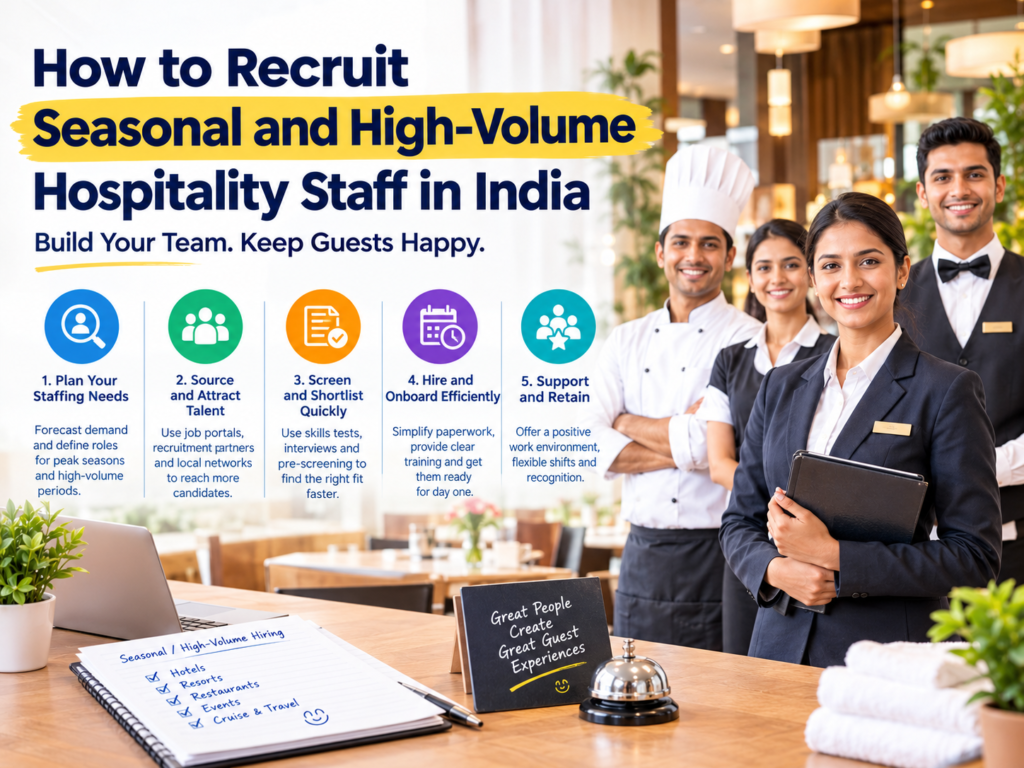
The hospitality industry depends on having the right people available at the right time. Hotels, resorts, restaurants, catering companies, event venues, and hospitality groups often need to recruit additional employees during holiday seasons, wedding periods, festivals, major events, and new property openings.
However, hiring a large number of employees within a short timeframe can be challenging. Businesses may struggle with candidate shortages, interview scheduling, inconsistent service standards, employee turnover, and recruitment costs. Without a clear hiring plan, these challenges can affect daily operations and guest satisfaction.
This is where a structured recruitment strategy becomes essential. By working with experienced hospitality consultants in India, businesses can streamline candidate sourcing, improve screening, and manage seasonal and bulk hiring requirements more efficiently.
In this guide, we explain how employers can plan, manage, and optimize seasonal and high-volume hospitality staff recruitment in India.
What Is Seasonal and High-Volume Hospitality Recruitment?
Seasonal hospitality recruitment involves hiring employees for specific periods when business demand increases. For example, hotels may need additional housekeeping staff during holidays, while restaurants and catering companies may require more kitchen and service employees during wedding season.
High-volume hospitality recruitment involves hiring multiple employees within a defined period. This may be necessary when a hotel opens a new property, a restaurant chain expands, or a hospitality group recruits staff across several locations.
Depending on business requirements, employers may need to recruit for roles such as:
- Hotel front desk executives and guest relations staff
- Housekeeping attendants and supervisors
- Chefs, kitchen assistants, and food preparation staff
- Restaurant managers, waiters, and service associates
- Banquet and catering staff
- Event coordinators and hospitality support teams
- Hotel operations managers and department heads
- Customer service and reservation executives
A well-planned recruitment process helps businesses prepare for increased demand without compromising service quality.
Why Is Seasonal Hospitality Hiring Challenging?
Hospitality businesses often operate under strict deadlines. When occupancy rates increase or large events are scheduled, employers may need to fill several vacancies simultaneously.
Some common recruitment challenges include:
1. Sudden Increases in Staffing Requirements
Hotels, resorts, restaurants, and catering businesses may experience rapid increases in demand during peak periods. If hiring begins too late, existing employees may face heavier workloads, affecting productivity and guest experience.
2. Shortage of Suitable Candidates
Finding candidates with the right experience, communication skills, customer service approach, and availability can be difficult, particularly when multiple employers recruit at the same time.
3. Limited Time for Screening
High-volume recruitment can generate a large number of applications. Reviewing every profile manually can delay shortlisting and make it harder for HR teams to focus on suitable candidates.
4. Recruitment Budget Constraints
Hiring temporary employees involves more than salaries. Businesses may also need to account for recruitment costs, training, uniforms, onboarding, accommodation where applicable, and additional shift coverage.
Companies looking for Best Discounted Prices for Companies Requiring Staffing & Hiring in India should compare the complete recruitment cost, service scope, and candidate quality instead of choosing a provider based only on the lowest quotation.
5. Employee Turnover and Attendance Issues
Seasonal positions may experience higher turnover because of temporary employment arrangements, demanding schedules, or changing employee availability. Employers should communicate shift expectations, compensation, contract duration, and workplace policies clearly before hiring.
Step-by-Step Guide to Recruiting Seasonal and High-Volume Hospitality Staff in India
Step 1: Forecast Your Staffing Requirements
Start by estimating how many employees your business will need during the upcoming peak period.
Review historical occupancy rates, restaurant reservations, event bookings, customer demand, and planned business expansion. Identify departments that may require additional staff and determine when those employees must be ready to start work.
For example, a hotel preparing for a busy holiday period may require additional housekeeping attendants, front office executives, kitchen assistants, and food and beverage staff.
Prepare a hiring plan that includes:
- Number of vacancies by department
- Required experience and skills
- Work location and shift schedules
- Employment duration
- Expected joining dates
- Approved recruitment budget
A clear workforce plan helps recruitment teams prioritize urgent vacancies and allocate resources appropriately.
Step 2: Prepare Clear Job Descriptions
A detailed job description helps attract candidates who understand the position and its requirements.
Include the job title, responsibilities, qualifications, experience, salary range where approved, working hours, location, contract duration, and expected joining date.
For seasonal positions, clearly mention whether the role is temporary, fixed-term, project-based, or potentially permanent.
Clear communication helps reduce unsuitable applications and prevents misunderstandings after candidates accept an offer.
Step 3: Choose the Right Recruitment Model
Different hospitality businesses require different hiring approaches. Some may need a small temporary team, while others may need to recruit dozens of employees across multiple departments.
Common recruitment models include:
Permanent recruitment: Suitable for long-term positions and ongoing operational requirements.
Temporary or fixed-term hiring: Useful for seasonal demand, festivals, events, and short-term business requirements.
Bulk recruitment: Appropriate when several vacancies must be filled within a defined timeline.
Recruitment Process Outsourcing (RPO): Useful for businesses with recurring hiring requirements or multiple vacancies that need coordinated recruitment support.
Executive search: Appropriate for senior hotel managers, operations leaders, and other specialized leadership positions.
Businesses can explore Brightlist Global’s recruitment services to understand recruitment and staffing options for different workforce requirements.
Step 4: Work With Experienced Hospitality Consultants in India
When internal HR teams cannot manage the entire recruitment process, an external recruitment partner can provide additional sourcing and screening support.
Experienced hospitality consultants in India can help employers define job requirements, source relevant profiles, shortlist candidates, coordinate interviews, and manage recruitment communication.
Before selecting a recruitment partner, check whether the company understands hospitality roles, can support multiple vacancies, communicates clearly, and offers a process suited to your hiring schedule.
Brightlist Global provides hospitality recruitment solutions for hotels, resorts, restaurants, catering businesses, and other hospitality organizations. Its services include candidate sourcing, screening, permanent recruitment, staffing support, executive hiring, and recruitment for new property openings.
Learn more about Hospitality Recruitment Consultants in India and discuss your company’s workforce requirements.
Step 5: Build a Candidate Pipeline Before Peak Season
One of the most effective ways to manage seasonal recruitment is to begin sourcing candidates before the demand reaches its highest point.
Create a candidate pipeline for recurring positions such as housekeeping, food and beverage service, kitchen operations, front office, and banquet services.
A ready pipeline can help recruitment teams respond faster when vacancies arise. Employers should still verify each candidate’s availability and suitability before making an offer.
Maintain an organized recruitment tracker that records:
- Candidate name and contact details
- Position applied for
- Relevant experience
- Screening status
- Interview feedback
- Offer status
- Expected joining date
A structured tracker makes it easier to monitor multiple vacancies and identify delays.
Step 6: Standardize Candidate Screening
High-volume hiring does not mean compromising on quality. Employers should establish consistent screening criteria for each role.
For example, housekeeping candidates may be assessed on relevant experience, attention to detail, reliability, and ability to follow operational procedures. Front office candidates may require communication skills, customer service experience, and familiarity with reservation systems.
Screening may include:
- Resume and experience review
- Role-specific questions
- Communication and service assessments
- Employment reference checks, where appropriate
- Verification of relevant qualifications or certifications
- Background checks where lawful and appropriate
For specialized or regulated positions, verify any mandatory qualifications and eligibility requirements before employment.
A consistent screening process helps hiring managers compare candidates fairly and make more informed decisions.
Step 7: Speed Up Interviews and Hiring Decisions
Interview delays can result in suitable candidates accepting other opportunities. To reduce unnecessary waiting, agree on interview availability and decision-making responsibilities before recruitment begins.
For bulk hiring, consider scheduling interview days, using standardized evaluation forms, and assigning hiring managers to specific departments.
Keep candidates informed about the next steps, expected timelines, compensation, and employment conditions.
A streamlined process allows employers to manage several vacancies without losing visibility over individual candidates.
Step 8: Plan Onboarding and Staff Readiness
Recruitment is not complete when a candidate accepts an offer. New employees need to understand their responsibilities, reporting structure, shift schedules, safety requirements, and service standards.
Prepare onboarding checklists for each department and provide role-specific training before employees begin their regular duties.
For seasonal teams, make sure staff understand the contract duration, attendance requirements, payroll arrangements, and procedures for requesting leave or reporting an absence.
Effective onboarding helps employees become productive sooner and supports a consistent guest experience.
How to Control Seasonal Hospitality Recruitment Costs
Cost management is an important part of high-volume recruitment. However, the lowest recruitment fee does not always deliver the best overall value.
Companies comparing recruitment agencies should evaluate the full cost of hiring and the quality of the service provided.
Consider the following measures:
- Forecast vacancies early: Early planning can reduce last-minute recruitment pressure.
- Group similar vacancies: Standardized job descriptions and interviews can reduce repetitive administrative work.
- Prioritize essential skills: Avoid adding unnecessary requirements that limit the available candidate pool.
- Monitor recruitment performance: Track time-to-fill, interview-to-offer ratios, joining rates, and early attrition.
- Compare transparent quotations: Confirm what is included in recruitment fees and identify any additional charges.
- Review retention: Hiring candidates who fit the role and work environment can help reduce repeated recruitment expenses.
If your company is searching for Best Discounted Prices for Companies Requiring Staffing & Hiring in India, request a quotation based on the number of vacancies, role seniority, location, hiring model, and expected timeline.
A clear scope of work makes it easier to compare providers fairly and choose a recruitment solution that fits your operational and financial needs.
How to Compare the Top 10 Hospitality Consulting Options in India
Companies researching the top 10 hospitality consulting or recruitment options in India should compare agencies based on their actual capabilities rather than relying solely on online rankings.
The right recruitment partner depends on the size of your business, the number of employees required, the locations involved, and the type of hospitality roles you need to fill.
Use these criteria when comparing providers:
- Hospitality recruitment experience
- Ability to handle bulk and seasonal hiring
- Candidate sourcing and screening process
- Coverage across your required locations
- Availability of permanent, temporary, and contract hiring options
- Experience recruiting frontline and management professionals
- Communication and recruitment reporting
- Transparent pricing and service terms
- Reference checks and candidate verification procedures
- Support during interviews and onboarding
When evaluating the top hospitality consultants in India, ask each provider to explain how it would manage your specific hiring volume and deadline.
Avoid selecting an agency based only on a “top 10” list or an unverified ranking claim. A provider’s ability to meet your company’s recruitment requirements is more important than a generic position on a list.
Why Consider Brightlist Global for Hospitality Recruitment?
Brightlist Global provides recruitment and staffing solutions for businesses across multiple industries, including hospitality and service operations. Its hospitality recruitment services support businesses seeking frontline employees, experienced professionals, management talent, and teams for new property openings. Explore Brightlist Global’s hospitality recruitment services.
Companies can discuss their requirements for:
- Seasonal and bulk hospitality recruitment
- Hotel and resort staffing
- Restaurant and catering recruitment
- Front office and housekeeping roles
- Kitchen and food service positions
- Hospitality management and executive hiring
- Recruitment support for new property openings
The recruitment process can be structured around the employer’s job requirements, candidate screening criteria, hiring timeline, and staffing needs.
Brightlist Global also offers recruitment services in other sectors, including IT recruitment. However, for this article, the primary focus is hospitality staffing rather than IT recruitment.
To discuss a hiring requirement, visit the Brightlist Global contact page
Common Mistakes to Avoid in High-Volume Hospitality Hiring
Even an urgent hiring campaign can be managed effectively when employers avoid common mistakes.
Starting recruitment too late: Begin workforce planning well before the expected peak season.
Using unclear job descriptions: Communicate duties, shift requirements, compensation, location, and contract duration clearly.
Focusing only on candidate quantity: A large number of applications does not guarantee suitable hires.
Delaying interview feedback: Establish clear decision deadlines and communicate with candidates promptly.
Ignoring employee readiness: Provide onboarding and role-specific training before employees begin work.
Choosing a provider based only on price: Evaluate screening quality, service scope, communication, and recruitment performance alongside cost.
Failing to measure results: Review hiring timelines, joining rates, vacancy completion, and early turnover to improve future recruitment campaigns.
Conclusion
Recruiting seasonal and high-volume hospitality staff in India requires planning, efficient candidate sourcing, consistent screening, and a clear onboarding process. Businesses that prepare ahead of peak periods are better positioned to manage vacancies, control recruitment costs, and maintain service standards.
Working with experienced hospitality consultants in India can help companies coordinate multiple vacancies and develop a recruitment process suited to their operational requirements.
Whether your business operates a hotel, resort, restaurant, catering company, or hospitality group, choose a recruitment partner based on its capabilities, transparency, and ability to support your hiring goals.
Need support with seasonal or bulk hospitality hiring? Contact Brightlist Global to discuss your workforce requirements and explore a recruitment solution tailored to your business.