
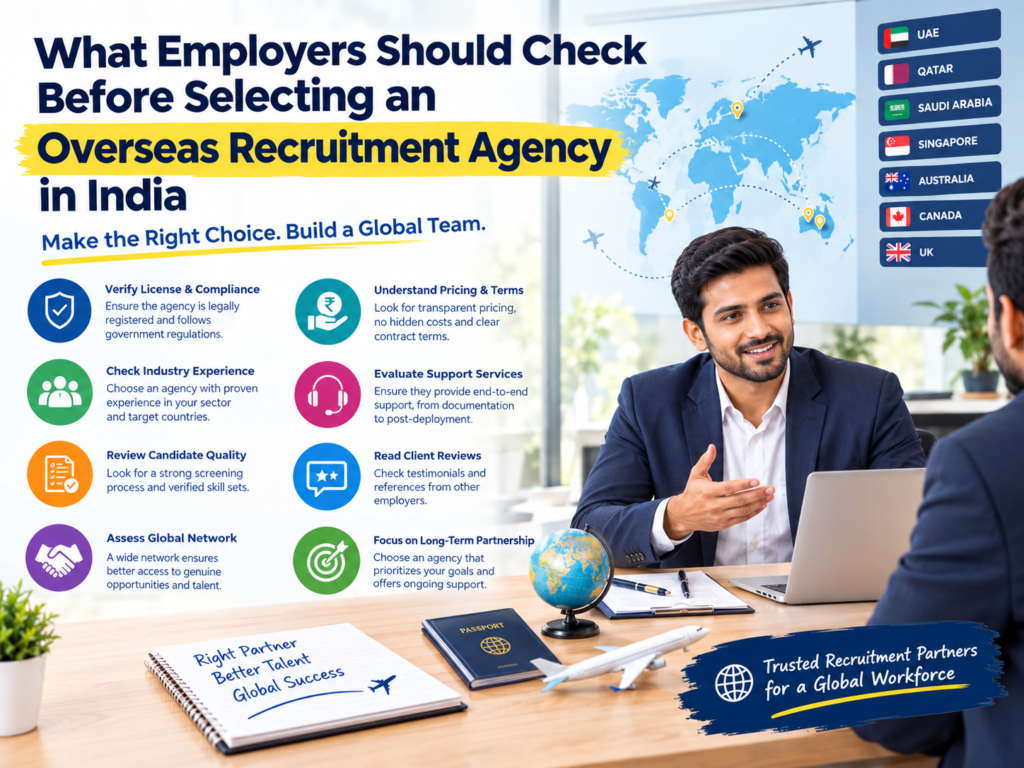
Hiring employees from India for international positions can help businesses access skilled professionals, technical experts, and experienced manpower across multiple industries. However, overseas recruitment involves more than finding suitable candidates. Employers must also evaluate recruitment quality, communication, costs, documentation, and compliance with applicable employment regulations.
Choosing the wrong recruitment partner can lead to unsuitable candidates, hiring delays, unexpected expenses, and difficulties during onboarding. For this reason, companies should carefully evaluate an agency before entering into a recruitment agreement.
Whether you are hiring IT professionals, engineers, healthcare workers, hospitality staff, or skilled manpower for overseas projects, selecting the right recruitment partner can make the process more organized and efficient.
This guide explains what employers should check before choosing an Overseas Recruitment Agency in India, how to compare providers, and how to identify a recruitment partner that aligns with their business requirements.
Why Choosing the Right Overseas Recruitment Agency Matters
International recruitment often involves several stages, including candidate sourcing, screening, interviews, employment documentation, and coordination between employers and candidates in different countries.
An experienced recruitment partner can help businesses manage these stages while reducing the administrative effort required from internal HR teams.
Before selecting among overseas recruitment agencies in India, employers should understand their hiring requirements and assess whether an agency can support the roles, locations, and recruitment timelines involved.
A suitable recruitment partner should be able to explain its process clearly, provide relevant candidate profiles, communicate recruitment progress, and help coordinate the required hiring activities.
10 Things Employers Should Check Before Selecting an Overseas Recruitment Agency in India
1. Industry-Specific Recruitment Experience
The first step is to evaluate whether the agency understands your industry and the positions you need to fill.
Recruiting a software developer requires a different screening approach from recruiting a construction engineer, healthcare professional, hospitality manager, or skilled technician.
Ask the recruitment agency about its experience with similar roles, the qualifications it typically evaluates, and how it identifies candidates with relevant industry experience.
For example, an engineering company hiring for an overseas infrastructure project may require candidates with specific technical qualifications, project experience, and knowledge of relevant safety standards.
An agency that understands these requirements can develop a more targeted sourcing and screening process.
Brightlist Global provides recruitment solutions across industries such as IT, engineering, construction, healthcare, manufacturing, hospitality, oil and gas, and logistics.
Explore the Overseas Recruitment Agency in India services offered by Brightlist Global to understand how its recruitment process supports international employers.
2. Candidate Sourcing and Screening Methods
A large database of resumes does not automatically guarantee successful recruitment. Employers need candidates who match the job requirements and can perform effectively in the intended role.
Before selecting an agency, ask how it sources, evaluates, and shortlists candidates.
Important questions include:
- How does the agency identify candidates for specialized positions?
- Does it review qualifications and relevant work experience?
- Can it coordinate technical or role-specific assessments?
- Does it conduct reference checks when required?
- How does it verify candidate information?
- Can it explain why a shortlisted candidate matches the job description?
The screening process should reflect the requirements of the position and the destination country.
For regulated roles, employers should also verify relevant professional licences, certifications, and eligibility requirements before finalizing a candidate.
A clear screening process helps businesses compare applicants more consistently and make better-informed hiring decisions.
3. Understanding of International Recruitment Compliance
Compliance is one of the most important factors when choosing an overseas recruitment partner.
Employers should understand the legal requirements that apply to recruitment from India and employment in the destination country.
Depending on the recruitment arrangement, these may include:
- Applicable Indian overseas recruitment regulations
- Recruitment agent registration or authorization requirements
- Destination-country work permits and employment visas
- Qualification and professional licensing requirements
- Employment contracts and mandatory disclosures
- Background verification and identity checks
- Applicable labour laws and worker protection requirements
The Ministry of External Affairs provides official information on overseas employment and recruiting agents. Employers should verify the agency’s current registration or authorization through the relevant official channels where required.
You can begin with the Ministry of External Affairs website and its official overseas employment resources.
Do not rely solely on verbal assurances or an agency’s website. Confirm which party is responsible for each compliance requirement and obtain relevant documentation before proceeding.
The exact obligations depend on the destination country, job category, recruitment arrangement, and applicable law.
4. Transparent Recruitment Pricing and Service Agreements
Recruitment costs can vary depending on the number of vacancies, job seniority, sourcing requirements, screening activities, destination country, and complexity of the hiring process.
Companies looking for Best Discounted Prices for Companies Requiring Staffing & Hiring in India should compare the complete service offering instead of choosing a provider based only on the lowest quotation.
Request a written proposal that explains:
- Recruitment fees and payment milestones
- Services included in the quoted price
- Any additional screening or verification charges
- Replacement terms, if offered
- Expected recruitment timelines
- Candidate withdrawal or offer rejection procedures
- Responsibilities for travel, visa, and documentation costs
- Cancellation terms and other contractual conditions
For example, one agency may quote a lower recruitment fee but exclude certain verification activities, while another may include additional screening and recruitment coordination.
Comparing quotations on the same scope of work makes it easier to evaluate the actual value offered by each provider.
Avoid accepting vague pricing terms. A detailed agreement can reduce misunderstandings and help your company plan its recruitment budget more accurately.
5. Candidate Availability and Recruitment Timelines
International hiring can involve several stages, and timelines vary by role, location, candidate availability, and documentation requirements.
Before signing an agreement, ask the agency to explain its expected recruitment timeline and the factors that may affect delivery.
A typical recruitment process may include:
- Understanding the employer’s workforce requirements
- Preparing job descriptions and selection criteria
- Sourcing relevant candidates
- Screening and shortlisting applications
- Coordinating employer interviews
- Collecting feedback and managing offers
- Completing required checks and employment documentation
- Coordinating the remaining pre-employment steps
Ask the agency to identify the expected timeline for each stage and explain how progress will be reported.
A realistic recruitment plan is more useful than an unsupported promise to fill every vacancy within a fixed number of days.
6. Communication and Recruitment Coordination
Clear communication becomes especially important when the employer, recruitment agency, and candidates are located in different countries.
Before selecting an agency, confirm who will manage your account and how frequently you will receive updates.
A structured communication process should cover:
- Candidate profile submissions
- Interview scheduling
- Employer feedback
- Offer and joining status
- Documentation requirements
- Recruitment delays or candidate withdrawals
- Open vacancies and pending decisions
For companies hiring multiple employees, a shared recruitment tracker or regular status report can make it easier to monitor progress.
The agency should also have a clear escalation process for urgent vacancies or unresolved recruitment issues.
7. Ability to Handle Bulk and Specialized Hiring
Some businesses need to recruit one senior executive, while others require dozens of employees for international expansion or project-based operations.
Your recruitment partner should be able to explain how it would manage the specific volume and complexity of your hiring requirements.
For bulk recruitment, ask about its candidate sourcing capacity, screening workflow, interview coordination, and ability to manage multiple vacancies simultaneously.
For specialized hiring, ask how it identifies candidates with the required technical expertise, certifications, language skills, or international experience.
Employers should also clarify whether the agency can support recurring recruitment requirements or future workforce expansion.
The right partner should have a process suited to your actual hiring needs rather than offering the same approach for every company.
8. Client References and Recruitment Performance
Before selecting a recruitment agency, review its professional background and, where possible, speak with businesses that have used similar services.
Useful questions include:
- Has the agency recruited for comparable positions?
- Does it communicate consistently during the recruitment process?
- Are candidate profiles relevant to the agreed requirements?
- Does it provide clear recruitment progress reports?
- How does it handle rejected candidates or changing requirements?
- Are its commercial terms and service commitments clearly documented?
You can also ask the agency to explain how it measures recruitment performance.
Relevant metrics may include time-to-fill, candidate interview-to-offer ratios, offer acceptance rates, joining rates, and retention where tracked.
These measures should be interpreted in context. Recruitment outcomes depend on factors such as employer feedback, compensation, candidate availability, and the complexity of the position.
9. Post-Selection and Pre-Departure Coordination
Recruitment does not always end when a candidate accepts an offer. International hiring may require additional coordination before the employee can begin work.
Depending on the agreed scope, an agency may assist with documentation coordination, background checks, communication about employment conditions, and other pre-employment activities.
Employers should confirm exactly what support is included and which responsibilities remain with the company, the candidate, or another service provider.
For overseas employment, verify that the candidate understands the role, salary, work location, contract duration, and other relevant employment conditions.
Visa approval, work authorization, travel arrangements, and professional licensing should be handled according to the applicable rules and the responsibilities established in the agreement.
Clear coordination helps reduce avoidable delays and gives candidates a better understanding of the employment process.
10. A Recruitment Approach That Matches Your Business Goals
The best recruitment agency for your company is not necessarily the largest provider or the one offering the lowest price. It is the agency that can support your hiring requirements with an appropriate recruitment process and clearly defined responsibilities.
Before making a final decision, confirm that the provider understands:
- Your business objectives and hiring locations
- The number and type of vacancies
- Required experience and qualifications
- Your budget and commercial expectations
- Your recruitment timeline
- Candidate assessment standards
- Relevant employment and compliance requirements
- Reporting and communication expectations
Companies comparing options for the Top Recruitment Agency in India for Companies should use these criteria to assess suitability instead of relying on unsupported rankings or promotional claims.
How to Compare Overseas Recruitment Agencies in India
A structured comparison can help your HR or procurement team make a more objective decision.
Use the following checklist when evaluating potential recruitment partners.
Evaluation factor | What employers should verify |
Industry experience | Relevant experience recruiting for your sector and roles |
Candidate sourcing | A clear approach to finding suitable professionals |
Screening quality | Role-specific evaluation and appropriate verification |
Compliance | Understanding of applicable recruitment and employment requirements |
Pricing | Written quotation with transparent fees and service scope |
Timelines | Realistic recruitment milestones and reporting |
Communication | A designated contact and regular progress updates |
Bulk hiring | Ability to manage the number of vacancies required |
References | Relevant client feedback or demonstrable experience |
Contract terms | Clear responsibilities, payment terms, and service conditions |
Shortlist agencies that meet your essential requirements, then compare their proposals on the same basis.
This approach can help you identify a suitable recruitment partner while reducing the risk of unexpected costs or unclear service commitments.
Why Consider Brightlist Global for Overseas Recruitment?
Brightlist Global provides recruitment solutions for companies looking to hire professionals and skilled manpower from India for international workforce requirements.
Its recruitment services cover multiple industries, including IT, engineering, construction, healthcare, manufacturing, hospitality, oil and gas, and logistics.
Depending on the employer’s requirements, recruitment support can include:
- Understanding job requirements and workforce needs
- Candidate sourcing and CV screening
- Candidate shortlisting and assessment coordination
- Interview scheduling
- Background screening where required
- Recruitment communication and coordination
Brightlist Global’s approach is designed around the employer’s hiring requirements, industry, job roles, and recruitment objectives.
Businesses evaluating overseas recruitment agencies in India can review the company’s service details and discuss their specific workforce needs before deciding whether the recruitment arrangement is suitable.
Learn more about Brightlist Global’s overseas recruitment services.
You can also read How an Overseas Recruitment Agency in India Helps Companies Hire Global Talent for additional guidance on international recruitment.
To discuss your company’s requirements, visit the Brightlist Global contact page.
Common Mistakes Employers Should Avoid
Even experienced businesses can encounter recruitment problems if they do not evaluate their recruitment partner carefully.
Avoid these common mistakes:
Choosing an agency based only on price: Compare the complete service scope, candidate quality, and contractual terms.
Ignoring compliance checks: Verify relevant registration, authorization, and employment requirements before proceeding.
Accepting unrealistic hiring promises: Ask for a practical timeline based on the role and destination country.
Providing incomplete job descriptions: Share clear responsibilities, qualifications, experience requirements, salary details, and work location.
Failing to document responsibilities: Define who manages screening, documentation, payments, and pre-employment coordination.
Not checking references: Where possible, review relevant client feedback and the agency’s recruitment experience.
Delaying candidate feedback: Establish clear interview and decision-making timelines to avoid losing suitable applicants.
Avoiding these mistakes can help companies establish a more organized recruitment process and make better hiring decisions.
Conclusion
Selecting the right Overseas Recruitment Agency in India requires careful evaluation of recruitment expertise, candidate screening, compliance, pricing, communication, and the ability to meet your workforce requirements.
For international employers, the goal should be to find a recruitment partner that understands the roles being filled, follows a clear process, communicates transparently, and defines responsibilities from the beginning.
Companies searching for overseas recruitment agencies in India should compare providers objectively and assess the complete value of their services instead of relying only on low prices or unverified rankings.
If your business is planning international expansion or needs skilled professionals from India, Brightlist Global can discuss recruitment solutions based on your industry, vacancies, and hiring objectives.
Looking to hire skilled professionals from India for your international business? Contact Brightlist Global to discuss your recruitment requirements.